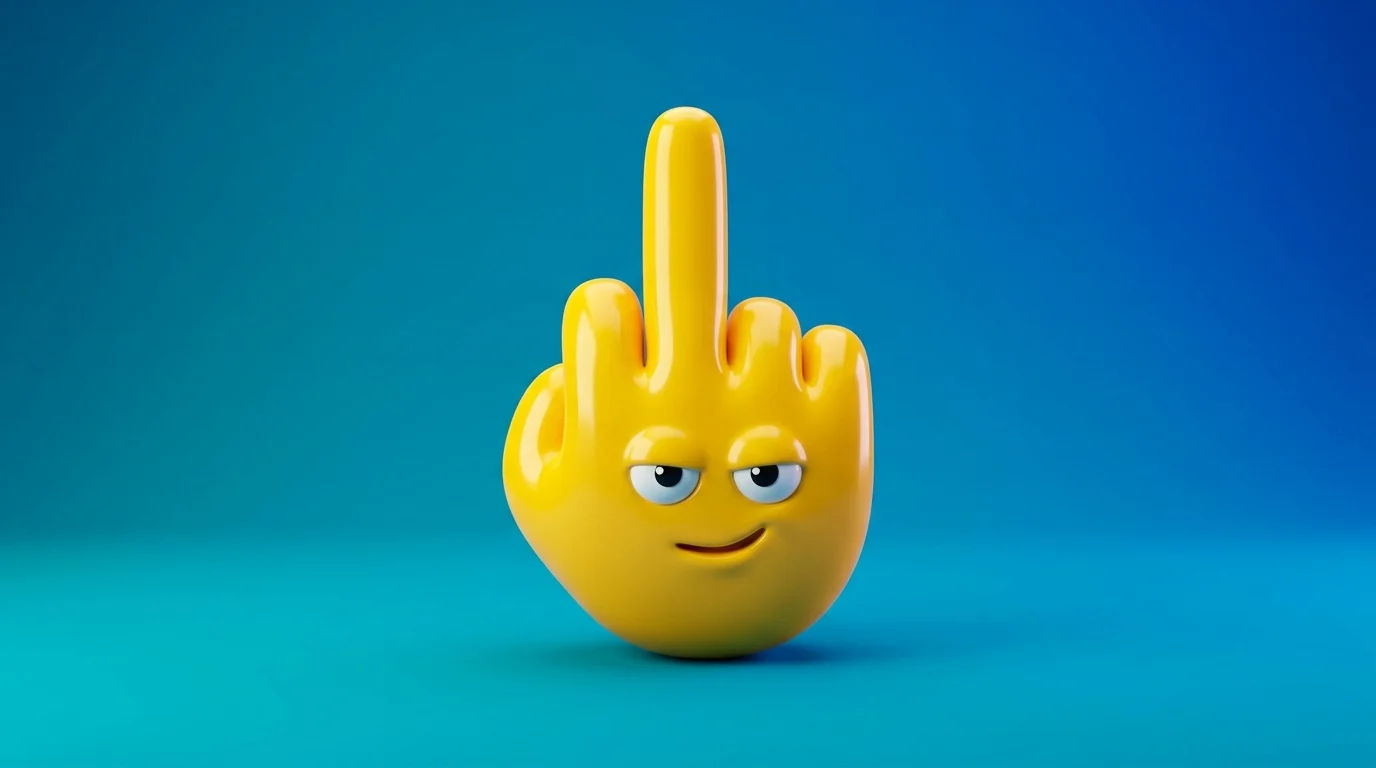
The flip off emoji 🖕 represents a raised middle finger and is commonly used to express anger, defiance, annoyance, disrespect, or rebellious humor. Its meaning depends heavily on context, relationship, and tone. In some conversations, people use it seriously as an insult, while friends may use it jokingly or playfully. Because the gesture is considered offensive in many cultures, it is important to understand when the emoji is appropriate and when it can easily cause misunderstanding.
Quick Answer: What Does the Flip Off Emoji 🖕 Mean?
The flip off emoji 🖕, officially represented by the middle-finger hand gesture, usually means “fuck you,” “go away,” “I’m angry,” or “I strongly disagree.” It can also be used jokingly between close friends.
Its interpretation depends on the situation:
| Use | Possible Meaning |
| 🖕 | Insult or strong disrespect |
| 🖕😡 | Anger or frustration |
| 🖕😂 | Joking or playful disrespect |
| 🖕🙄 | Annoyance or sarcasm |
| 🖕🔥 | Defiance or rebellious attitude |
| 🖕❤️ | Offensive-looking joke between close friends |
Unlike many hand emojis, this one generally carries a strong emotional or offensive meaning.
What Is the Flip Off Emoji?
The flip off emoji is the middle finger emoji, shown as a raised hand with the middle finger extended. The gesture is widely recognized as an insulting or offensive hand sign.
On most modern platforms, the emoji appears as 🖕, although its exact visual design can vary slightly between operating systems and devices.
The emoji belongs to the broader group of hand gesture emojis. However, unlike friendly gestures such as 👍 or 👋, it normally communicates hostility, sarcasm, frustration, or defiance.
The phrase “flip off” is an informal English expression meaning to make the middle-finger gesture toward someone.
What Does 🖕 Mean in Texting?
In texting, 🖕 can communicate several related emotions.
1. Anger
Someone might send:
“I can’t believe you did that 🖕”
Here, the emoji reinforces anger and disrespect.
2. Defiance
It can also communicate a rebellious attitude:
“I’m doing it my way 🖕”
In this situation, the emoji may mean “I don’t care what anyone thinks.”
3. Insult
When sent directly to another person without additional context, 🖕 can function as a strong insult.
For example:
“Get lost 🖕”
This is generally confrontational rather than playful.
4. Sarcasm
Close friends sometimes use the emoji sarcastically:
“Thanks for waking me up at 6 a.m. 🖕😂”
The laughing emoji changes the tone and can indicate that the sender is joking.
5. Frustration
The emoji may express frustration without necessarily being directed at a specific person:
“This traffic 🖕”
Here, it can mean that the sender is extremely annoyed with the situation.
Is the Flip Off Emoji Offensive?
Yes, the flip off emoji is generally considered offensive or vulgar because it represents the middle-finger gesture.
However, offensiveness depends on context.
Sending 🖕 to a stranger, customer, teacher, manager, family member, or professional contact can easily be interpreted as disrespectful. Sending it among close friends may have a completely different meaning if that group regularly uses sarcastic or playful language.
The safest approach is to consider who will receive it, why you are sending it, and how they normally communicate with you.
Flip Off Emoji Meaning by Context
The same emoji can communicate different things depending on the surrounding words.
| Message | Likely Interpretation |
| “Leave me alone 🖕” | Serious hostility |
| “You lost again 🖕😂” | Friendly teasing |
| “This weather 🖕” | Frustration |
| “Whatever 🖕” | Defiance or dismissal |
| “Love you too 🖕❤️” | Playful affection between close friends |
| “Seriously? 🖕” | Anger or disbelief |
| “I don’t care 🖕” | Rebellion or indifference |
The surrounding emojis are especially important. 😂, 🤣, 😭, or ❤️ may soften the apparent hostility, although they do not guarantee that the recipient will understand the joke.
How Is 🖕 Different From Other Angry Emojis?
The flip off emoji is more direct than many common anger-related emojis.
🖕 vs. 😡
😡 Angry Face communicates anger but does not directly insult another person.
🖕 is more confrontational because it represents an insulting gesture.
🖕 vs. 🤬
🤬 Face with Symbols on Mouth commonly represents swearing, intense anger, or frustration.
🖕 communicates the insult through a physical gesture rather than an implied swear word.
🖕 vs. 😤
😤 Face with Steam From Nose can represent frustration, irritation, determination, or pride.
🖕 has a much stronger disrespectful or provocative meaning.
🖕 vs. 🙄
🙄 Face With Rolling Eyes often means annoyance, disbelief, boredom, or sarcasm.
🖕 is considerably more aggressive.
When Do People Use the Flip Off Emoji?
People commonly use 🖕 in several situations.
During Arguments
The emoji can emphasize anger during a heated conversation.
“Stop blaming me for everything 🖕”
This is clearly confrontational.
In Memes and Humor
The emoji frequently appears in memes, jokes, reaction posts, and humorous captions.
The humor often comes from exaggerating frustration.
Between Close Friends
Some friends use offensive gestures affectionately. For example:
“Miss you, idiot 🖕😂”
Whether this works depends entirely on the relationship.
To Express Rebellion
The emoji can symbolize refusing to follow expectations or showing an “I don’t care” attitude.
To React to Annoying Situations
People may use it toward traffic, bad weather, technology problems, or frustrating circumstances.
“My internet stopped working again 🖕”
Here, it is aimed at the situation rather than a specific person.
Can 🖕 Be Used as a Joke?
Yes. The flip off emoji can be humorous when the relationship and context make the intention obvious.
For example:
“Nice haircut 🖕😂”
Between friends, this may be understood as playful teasing.
However, humor does not automatically make an offensive gesture harmless. Written messages lack facial expressions, voice tone, and body language, so jokes can sometimes be misunderstood.
Adding context can help:
“I’m kidding 😂🖕”
Even then, consider whether the recipient is comfortable with that style of humor.
Flip Off Emoji on Different Devices
The basic meaning of 🖕 remains consistent across major platforms, but its appearance can differ slightly.
Apple, Google, Microsoft, Samsung, and other platforms may use different artwork, hand shapes, colors, or visual details.
These differences usually do not change the fundamental meaning.
The important point is that the emoji represents a raised middle finger rather than a generic hand wave or pointing gesture.
Common Misunderstandings About 🖕
“It always means serious anger.”
Not necessarily. Friends may use it playfully or sarcastically.
“Adding 😂 makes it completely harmless.”
Not always. The recipient can still interpret the gesture as rude.
“It is just another hand emoji.”
No. Its cultural meaning is significantly stronger than many ordinary hand gestures.
“Everyone understands it the same way.”
The gesture is widely recognized, but social expectations differ across cultures, relationships, and situations.
“It is appropriate for professional messages.”
Generally, it is risky in professional communication because it can easily be interpreted as disrespectful.
How to Use the Flip Off Emoji Without Causing Unnecessary Confusion
If you decide to use 🖕, context matters.
Know Your Audience
Consider whether the recipient is a close friend, relative, coworker, customer, or stranger.
Consider the Conversation
If the discussion is already serious or tense, the emoji can escalate the situation.
Use Supporting Emojis Carefully
Adding 😂 or 🤣 can signal humor, while 😡 can reinforce anger. But supporting emojis cannot guarantee how someone will interpret the message.
Avoid It in Formal Communication
Emails, workplace messages, customer support conversations, academic communication, and official correspondence generally require a more respectful tone.
Think About Cultural Differences
Hand gestures do not carry identical social meanings everywhere. When communicating internationally, it is especially useful to avoid gestures that may be interpreted negatively.
Examples of Flip Off Emoji Messages
Here are some examples showing different tones:
Angry:
“Don’t talk to me like that 🖕”
Frustrated:
“This foolish computer crashed again 🖕”
Sarcastic:
“Thanks for absolutely nothing 🖕😂”
Playful:
“Of course you won again 🖕🤣”
Defiant:
“I’ll do what I want 🖕”
Reaction:
“Seriously?! 🖕”
Friendship humor:
“Good morning, loser 🖕😂”
The words around the emoji are often more important than the emoji alone.
Flip Off Emoji vs. Middle Finger Emoji
“Flip off emoji” and “middle finger emoji” generally refer to the same emoji: 🖕.
The difference is primarily in wording.
- Flip off is an informal expression describing the gesture.
- Middle finger describes the actual finger and gesture.
- Middle finger emoji is a common descriptive name for 🖕.
- Flipping someone off means making the gesture toward them.
Therefore, if someone searches for “flip off emoji,” “middle finger emoji,” or “middle finger hand emoji,” they are generally looking for the same symbol.
Common Mistakes When Using 🖕
One common mistake is assuming that everyone will understand the emoji as a joke. Humor depends heavily on the relationship between people.
Another mistake is sending it during a serious disagreement. A message that might have been interpreted as mild frustration can become much more aggressive when 🖕 is added.
Using it with people you barely know is also risky. The recipient may not understand your intended tone.
A final mistake is using the emoji in professional communication. Even if intended humorously, it can make a message appear disrespectful or unprofessional.
Practical Tips for Choosing the Right Emoji
If you are angry but want to avoid an explicit insult, consider 😤, 😠, or 🙄.
If you are frustrated, 😩, 😫, or 😤 may communicate the feeling without directly insulting someone.
If you are joking with a close friend, 🖕 may work when your relationship already supports that type of humor.
If you are communicating with a professional contact, a neutral emoji—or no emoji—is usually clearer.
The best emoji is not simply the one that expresses your emotion most strongly. It is the one that communicates your intended tone without creating unnecessary confusion.
Frequently Asked Questions
1. What does the 🖕 emoji mean?
The 🖕 emoji represents the middle-finger gesture and commonly expresses anger, disrespect, defiance, frustration, or an offensive joke.
2. Is the flip off emoji rude?
Yes. It is generally considered rude or offensive because the middle-finger gesture is widely used as an insult.
3. What does 🖕 mean from a friend?
A friend may use 🖕 seriously or jokingly. The meaning depends on your relationship, previous conversations, and surrounding emojis or words.
4. Can 🖕 mean “I love you”?
In some close friendships, people may combine an offensive gesture with affectionate language as a joke. However, 🖕 itself does not normally mean “I love you.”
5. What is another name for the flip off emoji?
Common descriptions include the middle finger emoji, middle-finger hand emoji, or simply middle finger.
6. Is 🖕 appropriate at work?
It is generally risky in professional communication. Even if intended humorously, coworkers or clients may interpret it as disrespectful.
7. What emoji can I use instead of 🖕?
For anger, consider 😡 or 😠. For frustration, 😤 or 😩 may work. For sarcasm, 🙄 can communicate annoyance with less direct hostility.
8. Why does the flip off emoji look different on different devices?
Emoji artwork is created by individual platforms, so the hand’s shape, shading, and visual details can vary while the underlying meaning remains essentially the same.
Conclusion
The flip off emoji 🖕 is a powerful hand gesture that usually communicates disrespect, anger, frustration, defiance, or an offensive joke. Its meaning can change significantly depending on the words surrounding it, the relationship between the people involved, and the situation in which it is used. Among close friends, it may be playful, while in a serious or professional conversation, it can easily be interpreted as a direct insult.
Understanding the context behind 🖕 helps you communicate more clearly and avoid unnecessary misunderstandings. If you want to express strong emotion without directly insulting someone, other emojis such as 😤, 😡, 🙄, or 😠 can often communicate frustration or anger with less risk of offense.

I am Josiah Michael, an animal enthusiast and writer who loves exploring wildlife, animal behavior, fascinating facts, and unique nicknames while sharing simple, enjoyable knowledge with readers.