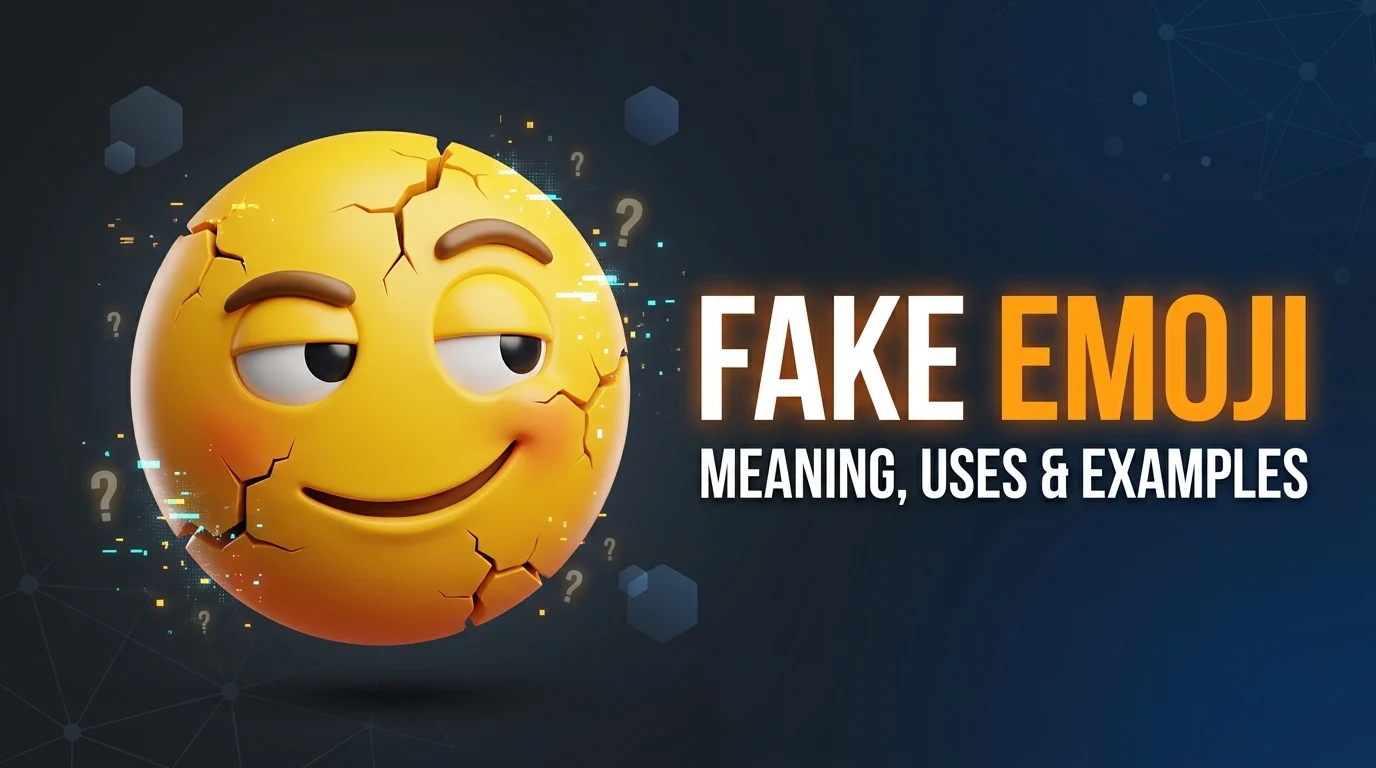
Fake emoji usually refers to an emoji-like symbol, image, sticker, or custom graphic that looks like a standard emoji but is not an official Unicode emoji. People use fake emojis in texts, social media posts, memes, comments, usernames, and online conversations to express reactions that ordinary emojis cannot capture.
The term can also describe emojis that appear unusual because of a device, app, font, keyboard, or custom emoji system. In some cases, what looks like a “fake emoji” is simply a sticker or an image designed to imitate the familiar emoji style.
Quick Answer
A fake emoji is an unofficial emoji-style symbol or image that resembles a normal emoji but is not necessarily part of the official Unicode emoji set. It may be a custom emoji, sticker, image, text symbol, or platform-specific graphic.
For example, someone might create a custom laughing face with an exaggerated expression and send it as an image. It may look exactly like an emoji in a chat, but technically it is not a standard Unicode emoji.
What Is a Fake Emoji?
A fake emoji is best understood as an emoji-style visual that is not a standard Unicode character.
Official emojis are standardized so that computers, phones, websites, and apps can recognize them as characters. A fake emoji does not necessarily follow that system. Instead, it may be created as an image, sticker, custom icon, or other graphic.
The difference can be difficult to notice because modern stickers and custom emojis often have the same small, colorful appearance as ordinary emojis.
Fake Emoji vs. Official Emoji
The main difference is how the visual is represented and supported.
| Feature | Official Emoji | Fake Emoji |
| Unicode character | Usually yes | Usually no |
| Works as normal text | Yes | Usually not |
| Can be copied as text | Yes | Often no |
| Appears across platforms | Generally supported, but designs vary | Depends on the app or image |
| Can be custom-made | No, not individually by ordinary users | Yes |
| Can be sent as an image | Not necessarily | Commonly |
| Appearance | Platform-specific design | Custom or imitation design |
An official emoji may look slightly different on Android, iPhone, Windows, or another platform. That does not make it fake. Different platforms can have their own artwork for the same standardized emoji.
Why Do People Use Fake Emojis?
People use fake emojis because standard emojis cannot represent every possible emotion, joke, reaction, or situation.
A custom emoji can communicate a very specific feeling. It might show an exaggerated facial expression, an inside joke, a funny character, or a reaction created specifically for a particular community.
Common reasons include:
- Creating a unique reaction
- Making messages more humorous
- Expressing emotions that standard emojis lack
- Building a personal online style
- Creating memes
- Supporting a brand or community
- Using custom reactions in group chats
- Making social media content more visually interesting
For example, a person might want an emoji showing someone laughing while crying, falling off a chair, or making a very specific sarcastic expression. If no standard emoji communicates the idea properly, a custom graphic can fill the gap.
Is a Fake Emoji a Real Emoji?
Not necessarily.
The word “emoji” is commonly used in everyday conversation to describe small digital pictures used in messages. Technically, however, an emoji can be a Unicode character or a graphic associated with an emoji character.
This distinction matters because a picture that looks like an emoji may behave completely differently from a Unicode emoji.
If you copy an official emoji from a message and paste it into another text field, it can usually be treated as text. If you copy a custom emoji image, you may instead copy an image file or nothing at all, depending on the application.
What Types of Fake Emojis Are There?
There is no single official category called “fake emoji.” The term can refer to several different things.
1. Custom Emojis
Custom emojis are created for a particular person, group, community, website, or messaging service.
They may resemble ordinary emojis while showing a unique character or expression.
2. Emoji Stickers
Stickers are larger graphics that can be sent in messaging apps. Some are designed to look almost identical to familiar emoji faces.
Because they are images rather than ordinary text characters, people sometimes call them fake emojis.
3. Emoji Images
A PNG, JPG, GIF, or other image can be designed to resemble an emoji.
These images can be used in social media posts, blogs, videos, presentations, memes, and messaging applications.
4. Platform-Specific Custom Reactions
Some communication platforms allow users or organizations to upload custom reaction graphics.
These can function like emojis inside that particular service, even though they are not universally recognized Unicode characters.
5. Emoji-Style Text Symbols
Some combinations of characters can create faces or expressions that resemble emojis.
Examples include:
- 🙂
- 😉
- 😀
- ¯\_(ツ)_/¯
- ♡
These are not necessarily emojis. They are text-based symbols or emoticons, although modern users sometimes use the terms interchangeably.
What Is the Difference Between an Emoji, Emoticon, Sticker, and Fake Emoji?
These terms are related but not identical.
| Term | Meaning | Typical format |
| Emoji | Standardized pictographic character | Unicode character |
| Emoticon | Expression made with keyboard characters | Text |
| Sticker | Graphic sent through an app | Image or animation |
| Custom emoji | App-specific or community-created reaction | Graphic |
| Fake emoji | Informal term for an emoji-like unofficial graphic | Image, sticker, symbol, or custom design |
For example, 🙂 is traditionally an emoticon, while 😂 is an emoji. A large laughing picture sent through a messaging app is more accurately described as a sticker.
Why Does a Fake Emoji Sometimes Look Like a Real Emoji?
Designers often imitate the familiar visual language of emojis.
That means a custom graphic may use:
- A round face
- Bright colors
- Simple facial features
- Small dimensions
- Bold expressions
- Familiar emotional symbols
- A transparent background
These design choices make the graphic instantly understandable.
The goal is usually not to confuse people. Instead, the familiar emoji style makes the reaction easy to recognize.
Can You Create Your Own Fake Emoji?
Yes. Creating a custom emoji-style graphic is relatively simple.
You can design one from scratch or modify an existing character concept. A simple custom emoji might contain a face, eyes, mouth, and one distinctive feature.
For example, you could create a face that:
- Has an oversized smile.
- Includes tears of laughter.
- Adds a funny hat.
- Uses an unusual facial expression.
- Represents an inside joke.
The final graphic can then be exported as an image and used as a sticker, reaction, social media graphic, or custom emoji where supported.
Tips for Creating a Good Fake Emoji
A good custom emoji should be recognizable even when displayed at a small size.
Keep the design:
- Simple
- High contrast
- Emotionally clear
- Easy to recognize
- Free from unnecessary details
- Suitable for the intended platform
A complicated illustration may look great at full size but become difficult to understand when reduced to the size of a normal emoji.
Can You Copy and Paste a Fake Emoji?
It depends on what kind of fake emoji it is.
If it is an ordinary Unicode character, you can usually copy and paste it like other text.
If it is an image or sticker, copying may work differently. Some apps let you copy or save the image, while others keep custom emoji graphics inside the application.
This is one of the easiest ways to tell the difference between an actual Unicode emoji and an emoji-style image.
Why Does My Emoji Look Different on Another Phone?
This does not automatically mean that one of the emojis is fake.
Unicode standardizes the underlying character, but companies can create their own visual designs for that character. As a result, the same emoji can have different appearances across platforms.
For example, an emoji showing a particular facial expression may have:
- Different eyes
- A different mouth
- Slightly different colors
- Different proportions
- A different overall style
The meaning can remain broadly the same even though the artwork changes.
Can Fake Emojis Be Used on Websites?
Yes.
Website owners and content creators can use emoji-style graphics as part of their designs. They can appear in blog posts, buttons, comments, illustrations, advertisements, memes, and social media embeds.
However, an image is not automatically a Unicode emoji simply because it looks like one.
For accessibility and usability, important information should not depend entirely on decorative emoji-style images. When an image communicates essential meaning, appropriate alternative text or surrounding text may be helpful.
Fake Emoji Examples
Here are some simple examples of what people might call fake emojis:
| Example | What it could be |
| A custom laughing face | Custom emoji |
| A celebrity reaction face | Sticker or image |
| A company mascot with an emoji expression | Branded graphic |
| A moving laughing face | Animated sticker or GIF |
| A hand-drawn sad face | Custom image |
| An unusual face created for a group chat | Custom reaction |
| 🙂 | Emoticon, not a standard emoji |
| A platform-only reaction icon | Custom platform graphic |
The exact classification depends on how the symbol is created and delivered.
Common Mistakes About Fake Emojis
Mistake 1: Thinking every unusual emoji is fake
An unfamiliar design does not necessarily mean the emoji is unofficial.
Different operating systems and applications can display the same standardized emoji differently.
Mistake 2: Calling every sticker an emoji
Stickers and emojis serve similar communication purposes, but they are technically different formats.
A sticker is generally a graphic, while a Unicode emoji can function as text.
Mistake 3: Assuming a custom emoji works everywhere
A custom emoji created for one messaging platform may not work on another service.
Platform compatibility is an important consideration when sharing custom graphics.
Mistake 4: Confusing emoticons with emojis
Text faces such as 🙂 and 😉 existed long before modern emoji systems. They are commonly called emoticons rather than emojis.
Mistake 5: Believing different artwork means different emoji
Two devices can display the same Unicode emoji with noticeably different artwork. The difference usually comes from platform-specific design rather than a difference in the underlying character.
Practical Tips for Using Fake Emojis
If you use custom emoji-style graphics online, a few simple practices can make them more effective.
Keep the meaning obvious
A person should understand the reaction quickly. Avoid overly complicated expressions.
Match the platform
Check whether the service supports custom emojis, stickers, animated graphics, or image uploads.
Use the right file format
Transparent PNG images can work well for static emoji-style graphics because they can blend naturally with different backgrounds.
Consider accessibility
If the graphic communicates important information, do not rely only on the picture. Supporting text can make the message clearer.
Avoid misleading designs
A custom emoji should not imitate an official symbol in a way that could cause confusion, particularly in professional or informational settings.
Respect copyright and trademarks
Do not assume that an image found online is free to copy. Creating an original design or using properly licensed artwork is safer for public use.
How to Find Out Whether an Emoji Is Official
If you want to determine whether a symbol is a standard emoji, consider how it behaves.
Ask these questions:
- Can you copy it as ordinary text?
- Does it appear inside the normal emoji keyboard?
- Does it have a consistent Unicode character identity?
- Does the same character display across different platforms?
- Is it actually an image or sticker?
If it behaves like an image rather than text, it is more likely to be a custom graphic or sticker.
Fake Emoji in Social Media and Messaging
Fake emojis have become particularly useful in online communication because visual reactions are quick and expressive.
Social media creators can use custom emoji-style images to develop a recognizable visual identity. Online communities can also create their own reactions based on jokes, characters, events, or recurring conversations.
In messaging, a custom reaction can communicate an emotion more precisely than a standard emoji.
For example, instead of simply sending 😂, someone might use a custom image showing a character laughing so hard that they fall backward. The second image communicates a more exaggerated reaction.
Frequently Asked Questions
1. What does fake emoji mean?
Fake emoji usually means an unofficial emoji-like graphic, sticker, custom reaction, or image that resembles a standard emoji but is not necessarily a Unicode emoji.
2. Is a fake emoji a real emoji?
Usually, no. The term generally refers to something that looks like an emoji but is technically an image, sticker, custom graphic, or another type of symbol.
3. Can I make my own fake emoji?
Yes. You can create an original emoji-style graphic using design or image-editing software and use it as a sticker, image, or custom reaction on supported platforms.
4. Why do emojis look different on different phones?
Different platforms create their own artwork for standardized emoji characters. Therefore, the same emoji can have different colors, shapes, facial expressions, or details depending on the device.
5. Is a sticker the same as a fake emoji?
Not exactly. A sticker is a graphic, while “fake emoji” is an informal term that can describe several emoji-like graphics, including stickers.
6. Can I copy and paste a fake emoji?
If it is a Unicode character, yes, it can generally be copied as text. If it is an image or sticker, copying depends on the application and format.
7. Are custom emojis available everywhere?
No. Many custom emojis are specific to the application, website, server, or community where they were created.
8. Is 🙂 a fake emoji?
Not technically. 🙂 is traditionally an emoticon made from text characters. People may casually describe it as an emoji-like symbol, but it is different from a Unicode emoji.
Conclusion
Fake emoji is a broad, informal term for graphics and symbols that resemble familiar emojis without necessarily being official Unicode emoji characters. Custom emojis, stickers, emoji images, platform-specific reactions, and some text symbols can all be described this way in everyday conversation.
Understanding the difference between official emojis, custom graphics, stickers, and emoticons makes online communication easier. Whether you want to identify a strange-looking symbol, create a custom reaction, or understand why an emoji appears differently on another device, knowing how these formats work helps you choose the right option for your message.

I am Josiah Michael, an animal enthusiast and writer who loves exploring wildlife, animal behavior, fascinating facts, and unique nicknames while sharing simple, enjoyable knowledge with readers.