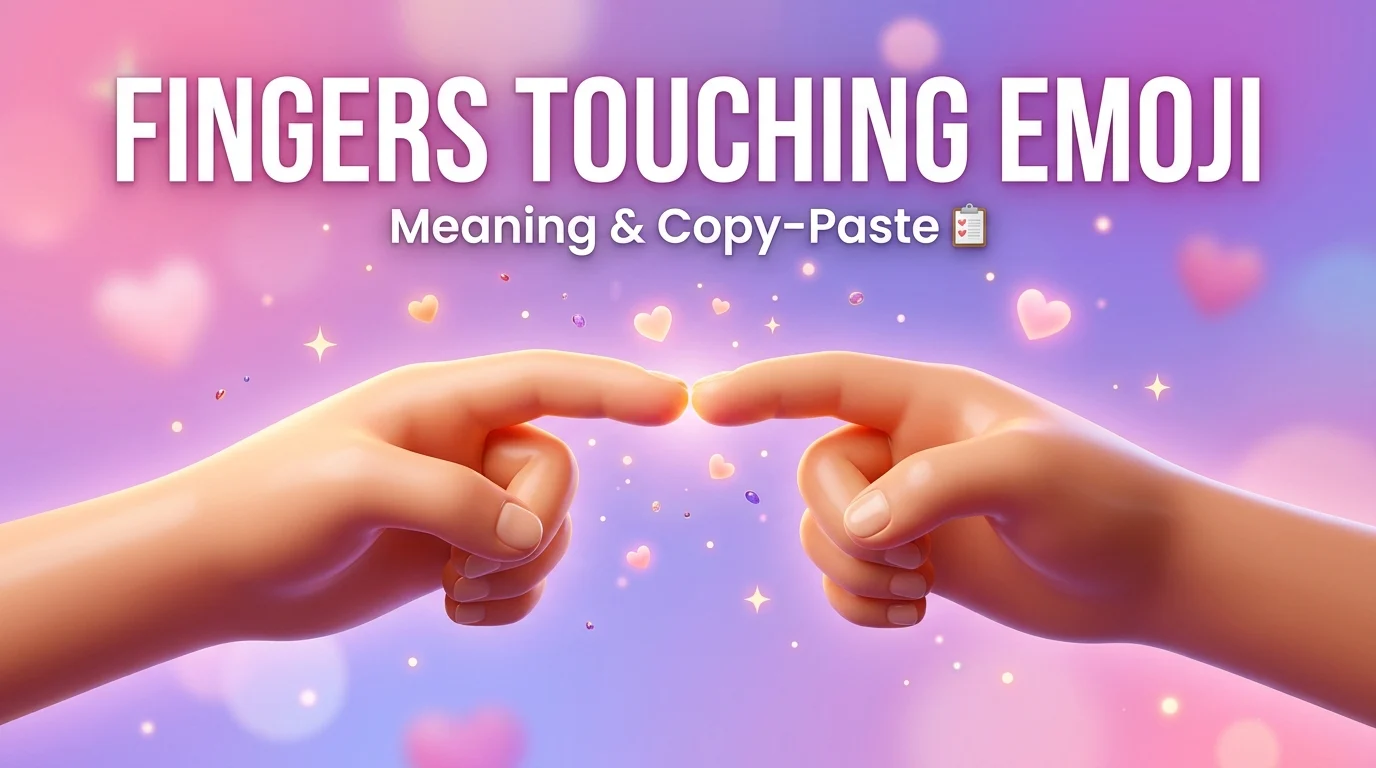
The fingers touching emoji usually refers to a hand gesture in which two fingers or fingertips appear to touch each other. Online, this gesture is often used to express shyness, hesitation, nervousness, awkwardness, embarrassment, cuteness, or a gentle request. Its meaning depends heavily on the specific emoji or emoji combination being used and the context of the conversation.
You may see the fingers touching gesture in texting, social media captions, memes, comments, and playful conversations. It became especially popular because the pose can communicate a subtle emotion without requiring a long explanation.
Quick Answer
The fingers touching emoji generally represents shyness, nervousness, embarrassment, hesitation, awkwardness, or a cute and timid reaction. It is often associated with the idea of two index fingers touching, particularly when someone wants to appear shy or unsure.
A common example is:
👉👈
This combination is widely used online to create the impression of two fingers touching. Depending on context, it can mean “I’m shy,” “Can I ask you something?”, “I’m nervous,” “I’m embarrassed,” or “Please?” in a cute or playful way.
What Does the Fingers Touching Emoji Mean?
The fingers touching gesture does not have one fixed meaning.
Its interpretation usually depends on the message surrounding it. The gesture can communicate a mixture of emotions rather than one specific feeling.
Common meanings include:
- Shyness
- Nervousness
- Embarrassment
- Hesitation
- Awkwardness
- Timidity
- Cuteness
- Uncertainty
- A gentle request
- Seeking reassurance
- Playful vulnerability
- Feeling bashful
The popular 👉👈 combination is especially associated with a shy or hesitant attitude.
For example:
“Can I ask you something? 👉👈”
Here, the gesture can make the request sound timid or nervous.
Another example:
“I kind of missed you 👉👈”
In this context, the gesture can make the statement feel more bashful and emotionally vulnerable.
What Is 👉👈 Called?
The combination 👉👈 is often described informally as the fingers touching emoji, shy emoji, or two fingers touching emoji.
Technically, however, it is not one single emoji character. It is a combination of two separate pointing-hand emojis.
The first hand points inward:
👉
The second hand points inward from the opposite side:
👈
Together, they visually suggest two index fingers touching:
👉👈
This combination became popular online because it creates a recognizable body-language gesture using standard emoji characters.
Why Does 👉👈 Look Shy?
Body language can communicate emotions without words.
When people imagine someone nervously touching their fingertips together, the gesture often suggests hesitation, shyness, uncertainty, or embarrassment.
The 👉👈 combination recreates that visual idea in text.
For example:
“I have a little favor to ask 👉👈”
The words already communicate the request, but the emoji combination adds a visual suggestion of hesitation.
Similarly:
“I think you’re really nice 👉👈”
The gesture can make the statement appear more bashful.
Fingers Touching Emoji Meaning in Texting
In texting, 👉👈 is often used when someone wants their message to sound softer, more hesitant, or more playful.
It can be used after:
- A personal question
- A compliment
- A request
- An apology
- A confession
- A nervous statement
- A playful comment
For example:
“Could you help me with something? 👉👈”
This can sound less direct than simply asking the question.
Another example:
“Do you maybe want to come with me? 👉👈”
The gesture can suggest that the sender feels nervous about asking.
Fingers Touching Emoji in Romantic Conversations
The gesture is also common in romantic or flirtatious conversations.
In this setting, it can suggest:
- Bashfulness
- Nervous attraction
- A shy confession
- Affection
- Playful flirting
- Wanting attention
- Feeling emotionally vulnerable
For example:
“I was hoping you would text me 👉👈”
Or:
“You looked really good today 👉👈”
The words themselves are relatively straightforward, while the gesture adds a shy or bashful tone.
However, 👉👈 does not automatically mean romantic interest. Context matters. Friends can use it jokingly, and people can use it simply to make an ordinary request sound cute.
Fingers Touching Emoji as a Cute Expression
One of the most common uses of 👉👈 is to make a message appear cute or timid.
This is particularly common in casual internet communication.
For example:
“Can I have the last cookie? 👉👈”
The gesture turns a simple request into a playful one.
Similarly:
“Please don’t be mad 👉👈”
Here, it can communicate nervousness and an attempt to soften the message.
Fingers Touching Emoji and Nervousness
The gesture can represent nervousness because touching one’s fingers can be associated with uncertainty or self-consciousness.
For example:
“I don’t know if I should say this 👉👈”
The emoji combination reinforces the idea that the speaker feels hesitant.
This makes it useful when the sender wants to show emotion without explicitly writing:
“I feel nervous.”
Fingers Touching Emoji and Embarrassment
The same gesture can communicate embarrassment.
For example:
“I accidentally sent that message to the wrong person 👉👈”
In this situation, the emoji can suggest awkwardness or embarrassment.
It can also be used after admitting something slightly embarrassing:
“Okay, I watched the whole series in one day 👉👈”
The gesture adds a playful sense of self-consciousness.
Fingers Touching Emoji and Asking for Something
Another common use is making a request sound gentle.
Compare:
“Send me the picture.”
with:
“Can you send me the picture? 👉👈”
The second version can feel softer and more playful.
Of course, the gesture does not guarantee that the request will be interpreted positively. Tone still depends on the relationship between the people communicating.
What Does 👉👈 Mean From a Girl or Guy?
There is no universal gender-specific meaning for 👉👈.
A girl, boy, man, or woman can use it to express shyness, hesitation, embarrassment, cuteness, or a playful request.
If someone sends 👉👈, you should interpret it based on:
- The exact message
- The relationship between the people
- The previous conversation
- Other emojis used
- The situation
- The person’s usual communication style
For example, “Can you help me? 👉👈” is probably just a shy or playful request.
On the other hand, “I really like talking to you 👉👈” may carry a more affectionate or romantic tone.
The emoji alone cannot establish someone’s intentions.
Fingers Touching Emoji Examples
Here are some natural examples of how the gesture is used:
| Message | Possible meaning |
| “Can I ask you something? 👉👈” | Hesitation or shyness |
| “Please don’t be angry 👉👈” | Nervousness or embarrassment |
| “I kind of missed you 👉👈” | Bashful affection |
| “Can you help me? 👉👈” | Gentle request |
| “I like your new profile picture 👉👈” | Shy compliment |
| “Do you want to hang out? 👉👈” | Nervous invitation |
| “I ate the last piece 👉👈” | Playful embarrassment |
| “Can I have one too? 👉👈” | Cute request |
These are examples rather than fixed definitions. The same gesture can communicate something different in another conversation.
Fingers Touching Emoji vs. Shy Emoji
People sometimes search for a “shy emoji” when they actually mean 👉👈.
There is no single standard emoji whose official meaning is simply “shy.” Instead, several emojis can communicate shyness or embarrassment depending on context.
For example:
- 👉👈 — shy or hesitant gesture
- 🥺 — pleading, emotional, or vulnerable expression
- 😳 — embarrassment or surprise
- 😊 — warmth, happiness, or gentle friendliness
- 😅 — nervousness or awkward relief
These emojis can also be combined.
For example:
🥺👉👈
creates a much stronger impression of pleading, shyness, or vulnerability than either symbol alone.
👉👈 vs. 🥺👉👈
These combinations are similar but can have slightly different emotional tones.
👉👈 focuses on the gesture itself. It suggests shyness, hesitation, or nervousness.
🥺👉👈 adds a pleading or emotionally vulnerable facial expression.
For example:
“Can you stay a little longer? 👉👈”
sounds shy.
“Please stay a little longer 🥺👉👈”
sounds more emotionally pleading.
Neither interpretation is guaranteed because online communication is highly contextual.
Is 👉👈 a Real Emoji?
The individual characters 👉 and 👈 are standard hand emojis, but 👉👈 as a combined “fingers touching” gesture is not one single Unicode emoji character.
It is a sequence of two separate emojis placed next to each other.
That distinction is useful because it explains why people may describe the combination as an emoji even though it technically consists of multiple characters.
Why Is the Fingers Touching Gesture Popular Online?
The popularity of the gesture comes from its ability to communicate an emotion visually.
Text alone can sometimes appear blunt.
For example:
“Can you help me?”
is perfectly normal, but it does not necessarily communicate how the person feels about asking.
Adding 👉👈 can suggest:
“Can you help me? I feel a little shy asking.”
The visual gesture provides emotional context without requiring additional words.
It is also short, recognizable, easy to type, and compatible with many platforms.
How to Use the Fingers Touching Emoji Naturally
If you want to use 👉👈 effectively, place it after a statement that benefits from a softer tone.
Good situations include:
Asking a favor
“Could you help me with this? 👉👈”
Giving a shy compliment
“Your new haircut looks really good 👉👈”
Making a nervous confession
“I actually missed talking to you 👉👈”
Making a playful request
“Can I have the last slice? 👉👈”
Showing embarrassment
“Okay, I made a tiny mistake 👉👈”
The key is to use it where the gesture makes sense emotionally.
Common Mistakes
Mistake 1: Assuming it always means flirting
👉👈 can appear in romantic conversations, but it does not automatically indicate flirting.
Friends, family members, and online communities can use it casually.
Mistake 2: Treating it as one emoji character
The visual combination is made from two separate pointing-hand emojis.
Mistake 3: Assuming it has one official meaning
Emoji combinations develop meanings through common usage, and context can change interpretation.
Mistake 4: Overusing it
Adding 👉👈 to every sentence can make the gesture lose its emotional effect.
Mistake 5: Ignoring the surrounding message
The words around the emoji are often more important than the emoji itself.
Practical Tips for Using 👉👈
Use the fingers-touching gesture when you want to add a sense of shyness, hesitation, vulnerability, or playful cuteness.
Keep these tips in mind:
- Use it after a request when you want a softer tone.
- Use it with a compliment to make it sound bashful.
- Combine it with 🥺 when you want a pleading tone.
- Use it with 😳 when embarrassment is the main emotion.
- Avoid using it in highly formal communication.
- Consider your relationship with the recipient.
- Do not assume the recipient will interpret it exactly as you intended.
For professional emails, official notices, or serious conversations, plain language is usually clearer.
FAQs:
1. What does the fingers touching emoji mean?
The fingers touching emoji, commonly represented as 👉👈, usually means shyness, hesitation, nervousness, embarrassment, or a cute and timid reaction.
2. What is the fingers touching emoji called?
It is commonly called the fingers touching emoji, shy emoji, or two fingers touching emoji. These are informal descriptions rather than one official name for the combined gesture.
3. Is 👉👈 one emoji?
No. 👉👈 is a combination of two separate pointing-hand emojis placed next to each other to create the appearance of touching fingers.
4. Does 👉👈 mean flirting?
It can be used in flirtatious or romantic conversations, but it does not automatically mean flirting. It can also express shyness, hesitation, embarrassment, or a playful request.
5. What does 👉👈 mean from a girl?
It has no fixed meaning based on gender. A girl may use it to express shyness, nervousness, affection, embarrassment, or simply a cute reaction. The surrounding conversation provides the best context.
6. What does 👉👈 mean from a guy?
A guy can use it for the same general reasons: shyness, hesitation, nervousness, affection, embarrassment, or playful communication. The emoji alone does not establish romantic intent.
7. What does 🥺👉👈 mean?
The combination often creates a stronger impression of pleading, vulnerability, shyness, or cuteness. It is frequently used when someone wants to make a request sound especially gentle.
8. What is the difference between 👉👈 and 🥺?
👉👈 emphasizes a shy or hesitant gesture, while 🥺 emphasizes a pleading, vulnerable, or emotional facial expression. Together, they can create a stronger shy or pleading tone.
Conclusion
The fingers touching emoji, commonly written as 👉👈, is a simple but expressive way to add shyness, hesitation, nervousness, embarrassment, or playful cuteness to digital conversations. Although the two symbols are technically separate pointing-hand emojis, together they create a recognizable gesture that has developed a popular meaning online.
The most important thing to remember is that 👉👈 does not have one fixed interpretation. It can be cute, shy, nervous, affectionate, or simply playful depending on the message and relationship. Looking at the surrounding words and conversation is the best way to understand what the sender actually means.

I am Josiah Michael, an animal enthusiast and writer who loves exploring wildlife, animal behavior, fascinating facts, and unique nicknames while sharing simple, enjoyable knowledge with readers.