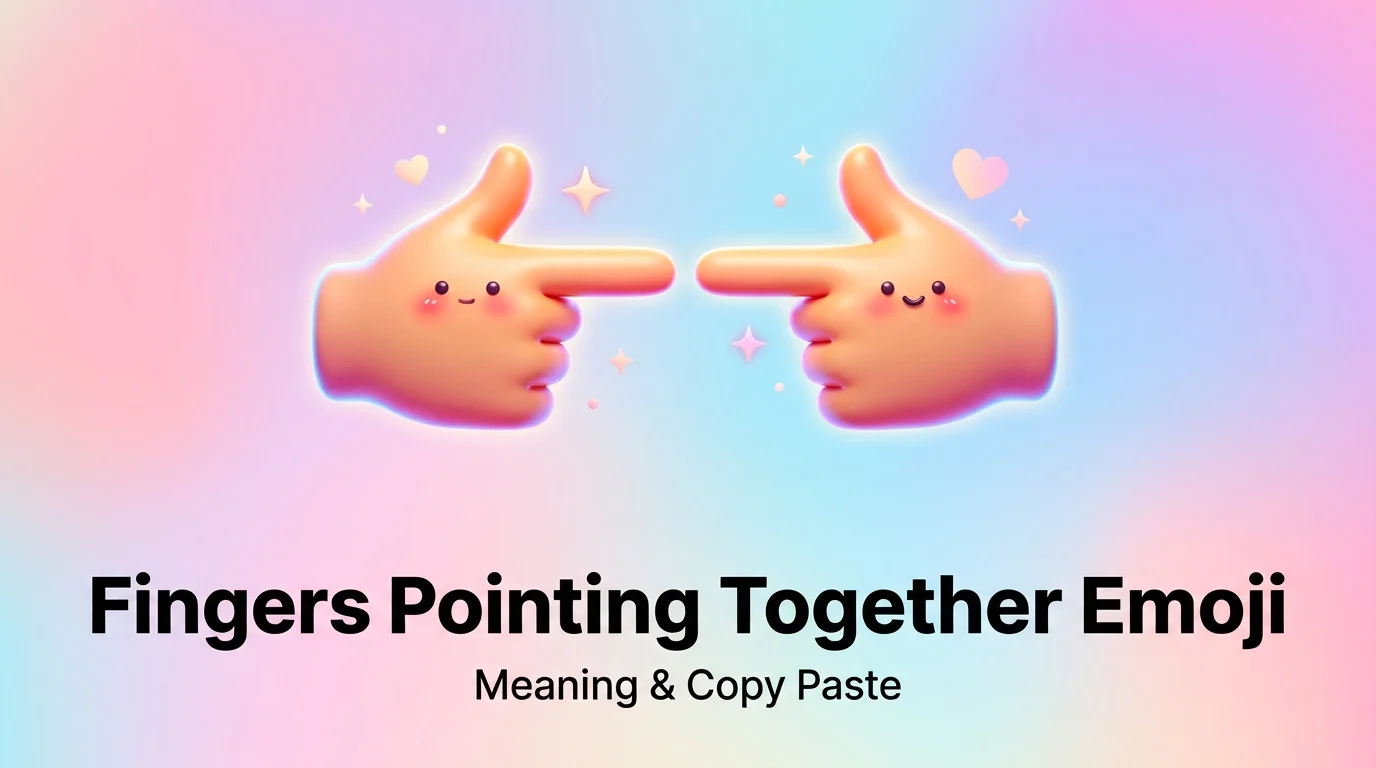
The fingers pointing together emoji usually refers to the shy, nervous, awkward, or hesitant hand gesture made by bringing two index fingers toward each other. It is commonly associated with shyness, embarrassment, nervousness, cuteness, hesitation, or asking for something in a soft and indirect way. People often use it in playful texts, social media captions, comments, and memes.
Because there is no single universally named Unicode emoji officially called the “fingers pointing together emoji,” people may use different combinations of hand emojis to create the gesture. The most familiar representation is often 👉👈, where the two index fingers point toward each other.
Quick Answer
The fingers pointing together emoji 👉👈 commonly means shyness, embarrassment, nervousness, hesitation, awkwardness, or a cute and timid reaction. It can also suggest “I’m shy to ask,” “Please?” or “I’m nervous.”
For example:
“Can I ask you something? 👉👈”
Here, the gesture makes the question sound softer, more hesitant, and playful.
What Does the Fingers Pointing Together Emoji Mean?
The fingers pointing together gesture is primarily a visual representation of two index fingers touching or pointing toward one another.
In online conversations, 👉👈 developed a meaning beyond the literal hand gesture. It became associated with an intentionally shy or bashful expression.
Depending on the context, it can communicate:
- Shyness
- Nervousness
- Embarrassment
- Hesitation
- Awkwardness
- Cuteness
- Timidity
- Uncertainty
- A gentle request
- Flirting
- Playful vulnerability
The meaning is usually emotional rather than literal.
For example:
“I wanted to tell you something 👉👈”
The gesture suggests that the speaker feels shy or nervous about what they are about to say.
Why Do People Use 👉👈 Together?
The two emojis create a visual gesture that resembles someone nervously touching their index fingers together.
The gesture is often associated with body language that suggests hesitation or self-consciousness.
Instead of simply writing:
“I’m nervous.”
Someone might write:
“I’m nervous 👉👈”
The emojis add a visual layer to the message.
Similarly:
“Can I have some? 👉👈”
can sound more playful or bashful than the same sentence without the emojis.
Is 👉👈 an Official Emoji?
The individual hand symbols are Unicode emojis, but 👉👈 is a combination of two separate emoji characters, not normally one single Unicode character representing “fingers pointing together.”
The right-pointing index emoji points toward the left, while the left-pointing index emoji points toward the right. When placed next to each other, they visually create the impression of fingers pointing inward.
This distinction is useful because the two symbols can be copied separately, rearranged, or combined with other emojis.
Fingers Pointing Together Emoji Copy and Paste
If you want the commonly used version, you can copy this:
👉👈
You can place it at the end of a sentence:
“Can I ask you something? 👉👈”
Or use it by itself for a shy reaction:
👉👈
The exact appearance can vary slightly between devices and platforms.
Fingers Pointing Together Emoji Meaning in Texting
In texting, 👉👈 is usually used to make a message appear more shy, hesitant, or cute.
Example 1: Asking a Favor
“Could you help me with this? 👉👈”
The gesture makes the request feel less direct.
Example 2: Asking for Something
“Can I have one too? 👉👈”
This can suggest playful shyness.
Example 3: Admitting Something
“I kind of like this song 👉👈”
The emoji can make the statement sound bashful.
Example 4: Starting an Awkward Conversation
“Um… can I tell you something? 👉👈”
Here, it communicates hesitation.
Example 5: Playful Flirting
“Maybe I missed you a little 👉👈”
The gesture can add a shy or flirtatious tone.
The meaning depends heavily on the words surrounding it.
What Does 👉👈 Mean From a Girl?
When a girl uses 👉👈, there is no single fixed meaning.
She might be expressing:
- Shyness
- Nervousness
- Embarrassment
- Playfulness
- A cute reaction
- Hesitation
- A gentle request
- Flirting
It is important not to automatically interpret the emoji as romantic interest. The surrounding conversation, relationship, and tone matter much more than the emoji itself.
For example:
“Can you send me the notes? 👉👈”
is likely just a playful way of asking for something.
Meanwhile:
“I think I like you 👉👈”
has a much more romantic context because of the words.
What Does 👉👈 Mean From a Boy?
The meaning is similar when a boy uses it.
A boy may use 👉👈 to appear:
- Shy
- Awkward
- Cute
- Nervous
- Playful
- Embarrassed
- Hesitant
Emoji meaning is not determined by gender. The context of the message is more important.
Does 👉👈 Mean “Please”?
Sometimes.
The fingers pointing together gesture can make a request look softer or more pleading.
For example:
“Can you please stay a little longer? 👉👈”
The emojis can communicate a playful version of “please.”
However, 👉👈 does not literally mean the word “please.” It is better understood as a visual expression of shyness or hesitation that can accompany a request.
Does 👉👈 Mean Shy?
Yes, shyness is one of its most common online meanings.
The gesture visually resembles someone who is too shy or nervous to make direct eye contact or speak confidently.
For example:
“I wanted to say hi, but I was too shy 👉👈”
The emoji reinforces the emotion described in the sentence.
Does 👉👈 Mean Flirting?
It can, but not always.
The gesture is sometimes used in romantic or flirtatious conversations because it creates a bashful tone.
For example:
“Maybe I was waiting for you to text me 👉👈”
could be interpreted as playful flirting.
But the same emoji can be completely non-romantic:
“Can you explain this homework question? 👉👈”
Therefore, the emoji alone is not enough to determine someone’s intentions.
Fingers Pointing Together Emoji vs. Other Shy Emojis
Several emojis can communicate related emotions, but they have different nuances.
| Emoji | Common meaning | Typical tone |
| 👉👈 | Shy, hesitant, bashful | Playful and timid |
| 🥺 | Pleading, emotional, cute | Soft or vulnerable |
| 😊 | Happy, warm, polite | Friendly |
| 😳 | Embarrassed, surprised | Stronger embarrassment |
| 🙈 | Embarrassed, hiding | Playful embarrassment |
| 🫣 | Shy, nervous, peeking | Very expressive |
| 😅 | Nervous or awkward | Casual and humorous |
| 👉 | Pointing right | Direct attention |
| 👈 | Pointing left | Direct attention |
These meanings are common interpretations rather than strict rules.
What Is the Difference Between 👉👈 and 🥺?
The two combinations are often used together, but they communicate slightly different ideas.
👉👈 emphasizes shyness, hesitation, awkwardness, or bashfulness.
🥺 often emphasizes pleading, vulnerability, sadness, or an exaggerated cute expression.
For example:
“Can I come with you? 👉👈”
sounds shy and hesitant.
“Please let me come with you 🥺”
sounds more pleading or emotionally persuasive.
Using both can intensify the cute or vulnerable tone:
“Can I come too? 🥺👉👈”
What Is the Difference Between 👉👈 and 🫣?
Both can communicate shyness or embarrassment.
However, 🫣 directly depicts a face peeking through fingers, while 👉👈 focuses on the hand gesture of two fingers pointing inward.
👉👈 often feels more playful, bashful, or internet-style.
🫣 can suggest:
- Embarrassment
- Nervousness
- Fear of looking
- Awkward curiosity
- “I can’t watch this”
The choice depends on the emotional nuance you want.
How to Use the Fingers Pointing Together Emoji
Using 👉👈 is simple, but the surrounding words determine the message.
For a shy request
“Can you help me? 👉👈”
For a cute confession
“I actually really like this 👉👈”
For nervousness
“I have something to tell you 👉👈”
For playful embarrassment
“Okay, maybe I did it 👉👈”
For a gentle request
“Can I have another one? 👉👈”
For playful flirting
“Were you waiting for me? 👉👈”
Again, the gesture does not automatically make a message romantic.
Fingers Pointing Together Emoji on Social Media
The 👉👈 combination is popular in informal online communication because it adds personality without requiring many words.
You may see it in:
- Social media comments
- Short captions
- Memes
- Messaging apps
- Fan communities
- Online forums
- Casual conversations
- Reaction posts
It works particularly well when the writer wants to make a sentence sound intentionally shy or playful.
For example:
“I may have bought another one 👉👈”
The emoji makes the confession humorous and bashful.
Examples of 👉👈 in Different Situations
| Situation | Example | Likely tone |
| Asking a favor | “Can you help me? 👉👈” | Shy |
| Asking for food | “Can I have some? 👉👈” | Playful |
| Confession | “I kind of like you 👉👈” | Bashful |
| Embarrassment | “Okay, I did it 👉👈” | Awkward |
| Flirting | “Were you thinking about me? 👉👈” | Playful |
| Nervous announcement | “I have something to say 👉👈” | Hesitant |
| Requesting attention | “Look at me for a second 👉👈” | Cute/playful |
| Asking permission | “Can I join you? 👉👈” | Gentle |
Common Mistakes When Using 👉👈
Mistake 1: Assuming it always means flirting
It does not.
The same gesture can be used for ordinary requests, jokes, embarrassment, or nervousness.
Mistake 2: Treating it as one official emoji
👉👈 is generally a sequence of two separate pointing-hand emoji characters rather than one single emoji character.
Mistake 3: Using it in formal communication
The gesture is strongly associated with casual internet language.
It may feel inappropriate in formal business emails, official notices, academic writing, or professional documents.
Mistake 4: Adding it to every sentence
Its effect comes from contrast. Using it repeatedly can make the message feel unnatural or exaggerated.
Mistake 5: Ignoring the surrounding words
Emoji interpretation depends on context. Never rely on 👉👈 alone to determine someone’s feelings or intentions.
Practical Tips for Using the Fingers Pointing Together Emoji
Use 👉👈 when you want to make a message feel shy, hesitant, cute, or playful.
It works particularly well after:
- A request
- A confession
- An awkward admission
- A playful question
- A nervous statement
- A humorous reveal
Keep the rest of the sentence natural. You generally do not need several additional emojis to communicate the same emotion.
For a softer tone, you can combine it with 🥺.
For embarrassment, 😳 or 🙈 may work better.
For a nervous but humorous message, 😅 can be a better choice.
The best emoji depends on the exact feeling you want to communicate.
FAQs:
1. What does the fingers pointing together emoji 👉👈 mean?
It commonly means shyness, hesitation, nervousness, embarrassment, awkwardness, or a cute and timid reaction.
2. Is 👉👈 one emoji?
No. It is generally a combination of two separate pointing-hand emoji characters placed next to each other to create an inward-pointing gesture.
3. Does 👉👈 mean “shy”?
Yes. Shyness and bashfulness are among its most common meanings in online conversations.
4. Does 👉👈 mean flirting?
It can be used flirtatiously, especially in romantic conversations, but it does not automatically mean flirting. Context is important.
5. What does 👉👈 mean from a girl?
It can mean shyness, nervousness, cuteness, hesitation, embarrassment, or playfulness. It should not automatically be interpreted as romantic interest.
6. What does 👉👈 mean from a boy?
It generally has the same meanings: shyness, awkwardness, hesitation, embarrassment, or playful vulnerability.
7. Can 👉👈 mean “please”?
It can make a request feel softer or more pleading, but the symbols themselves do not literally mean “please.”
8. What emoji is similar to 👉👈?
Emojis such as 🥺, 😳, 🫣, 🙈, and 😅 can express related feelings, although each has a slightly different emotional tone.
Conclusion
The fingers pointing together emoji 👉👈 is a popular combination used to express shyness, hesitation, nervousness, embarrassment, cuteness, or playful vulnerability. Its meaning is flexible, so the words around it are essential for understanding the intended message.
If you use it for a shy request, an awkward confession, a humorous admission, or a playful conversation, 👉👈 can add personality and emotion to ordinary text. Just remember that it does not automatically mean flirting or romantic interest; context determines how the gesture should be understood.

I am Caleb James, Administrator at AnimalsBuz. I love animals and enjoy sharing interesting facts, unique animal nicknames, and helpful information that makes learning about wildlife fun and engaging.