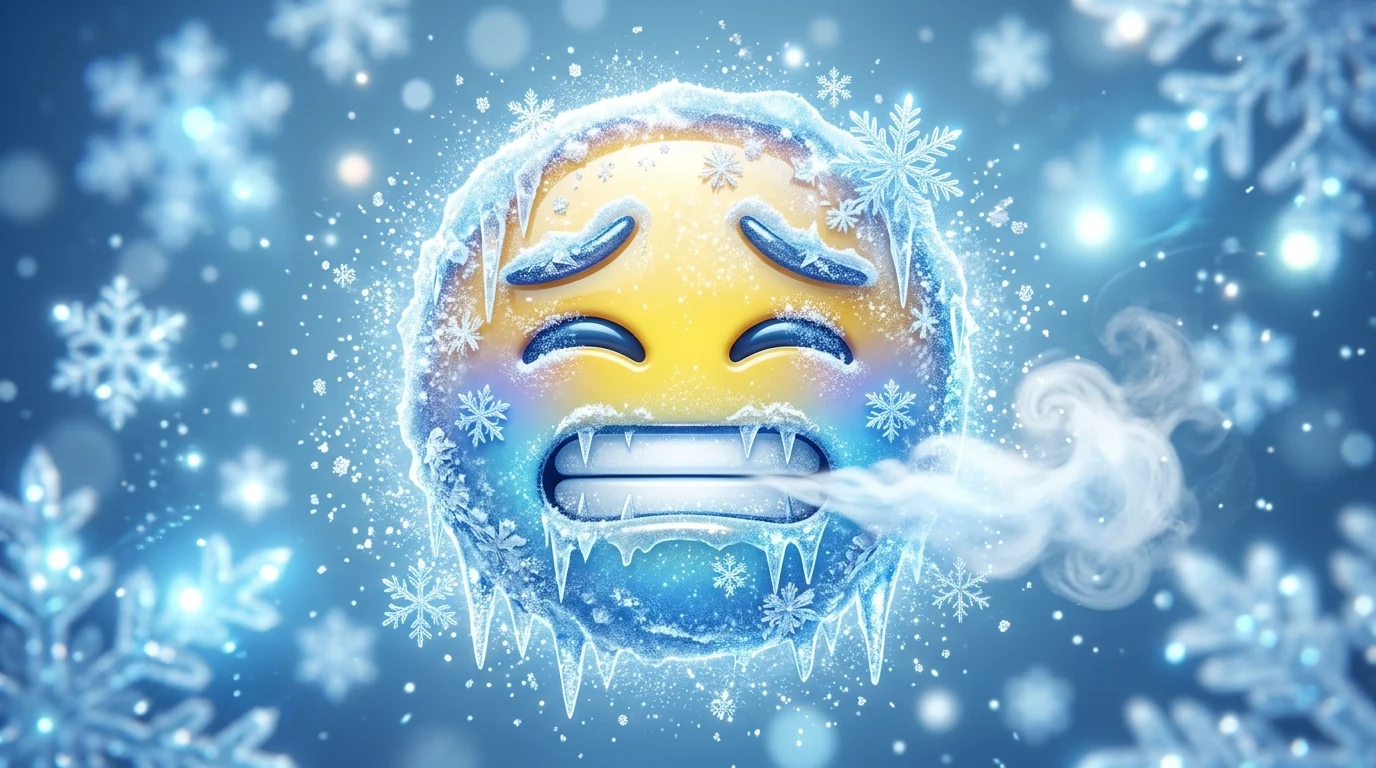
The frozen emoji 🥶 is commonly used to show that someone is extremely cold, freezing, or shivering. Its official Unicode name is Cold Face, while it was originally introduced under the name Freezing Face. The emoji shows a blue face with clenched teeth and icicles around the cheeks or chin. It can also express a figurative feeling of being “cold,” “chill,” shocked, or impressed depending on the conversation. Unicode identifies it as U+1F976, and it was added to Emoji 11.0 in 2018.
Quick Answer: What Does the Frozen Emoji 🥶 Mean?
The frozen emoji 🥶 mainly means “I’m freezing,” “It’s extremely cold,” or “This is so cold.” People use it when talking about winter weather, cold rooms, icy drinks, snow, or physically feeling cold.
It can also have informal meanings. In some conversations, 🥶 can mean someone is feeling awkward, emotionally cold, stunned, overwhelmed, or impressed by something extremely “cool.”
Frozen Emoji Copy and Paste
🥶
You can copy the frozen emoji above and use it in messages, captions, comments, posts, and chats.
What Is the Frozen Emoji Called?
Although many people search for it as the frozen emoji, its official Unicode and CLDR name is Cold Face. Unicode lists the character as U+1F976 🥶.
Emojipedia notes that the emoji was originally approved under the name Freezing Face in Unicode 11.0. Its visual design represents a face experiencing extreme cold, with clenched teeth and icicles suggesting freezing temperatures.
So, these search terms can refer to the same emoji:
- Frozen emoji
- Freezing emoji
- Cold emoji
- Freezing face emoji
- Cold face emoji
- 🥶 emoji
- Extreme cold emoji
- Shivering face emoji
The exact meaning depends on the surrounding message.
What Does 🥶 Mean in Texting?
In texting, 🥶 usually communicates extreme cold without needing a full sentence.
For example:
“It’s freezing outside 🥶”
Here, the emoji simply emphasizes how cold the weather feels.
But texting gives emojis additional emotional meanings. Someone might write:
“That exam was brutal 🥶”
In this context, 🥶 does not necessarily mean the person was physically cold. It can emphasize an intense or uncomfortable experience.
Another example is:
“That outfit is cold 🥶🔥”
Here, “cold” can mean stylish, impressive, or exceptionally cool. The exact interpretation comes from the words surrounding the emoji.
Frozen Emoji 🥶 Meaning in Different Situations
The frozen emoji can communicate several related ideas.
| Situation | Possible meaning of 🥶 |
| Winter weather | It is extremely cold |
| Snowfall | Freezing conditions |
| Cold room | I feel cold |
| Ice or frozen food | Something is very cold |
| Awkward moment | Things feel uncomfortable |
| Unexpected news | I am stunned or shocked |
| Stylish appearance | That is extremely cool |
| Competition | Calm, intense, or “cold-blooded” feeling |
| Casual slang | Cool, chill, or impressive |
These meanings are not equally common in every conversation. The most direct and widely understood meaning remains being very cold. Emojipedia also documents figurative uses connected with being “cold,” “cool,” or “chill.”
Why Does the Frozen Emoji Look Blue?
The blue color helps communicate the idea of extreme cold.
The emoji usually has a bluish face, tightly clenched teeth, and visible icicles. These visual details immediately suggest freezing temperatures or physical discomfort from cold weather.
Different platforms may draw the emoji somewhat differently. Apple, Google, Samsung, Microsoft, and other vendors can use their own artwork while representing the same underlying Unicode character.
This means 🥶 may look slightly different depending on the phone, operating system, browser, or app being used.
The meaning remains tied to the same Unicode character: U+1F976.
When Should You Use the Frozen Emoji 🥶?
1. Talking About Cold Weather
This is the most straightforward use.
Examples:
- “Winter is finally here 🥶”
- “It’s freezing outside today 🥶”
- “I forgot my jacket 🥶”
- “The temperature dropped so much 🥶”
The emoji makes the sentence more expressive and visually reinforces the idea of cold weather.
2. Talking About Ice and Snow
You can pair 🥶 with snow, ice, and winter-related emojis.
Examples:
- “First snowfall of the year 🥶❄️”
- “Everything is covered in ice 🥶🧊”
- “What a snowy morning 🥶☃️”
- “Winter vacation starts now 🥶🏔️”
3. Describing a Very Cold Place
The emoji can emphasize how cold a location feels.
Example:
“The mountains were beautiful but freezing 🥶🏔️”
Here, 🥶 adds emotion to the statement without changing its basic meaning.
4. Expressing an Uncomfortable Feeling
Sometimes people use the frozen emoji metaphorically.
For example:
“Everyone went silent after that question 🥶”
The emoji can suggest that the atmosphere suddenly became uncomfortable or tense.
This is more context-dependent than the literal cold-weather meaning.
5. Showing That Something Is Extremely Cool
In casual slang, “cold” or “cool” can describe something impressive or stylish.
Examples:
- “That new car looks amazing 🥶”
- “Your new shoes are cold 🥶”
- “That goal was unbelievable 🥶🔥”
In these cases, 🥶 works as an exaggerated reaction rather than a literal reference to temperature.
Frozen Emoji 🥶 vs. Other Cold-Related Emojis
Several emojis can communicate cold, winter, or ice, but they do not mean exactly the same thing.
| Emoji | Common meaning | Best use |
| 🥶 | Extremely cold or freezing | Feeling cold or reacting to intense cold |
| 🧊 | Ice | Ice, frozen objects, drinks |
| ❄️ | Snowflake or winter | Snow, winter, cold weather |
| ☃️ | Snowman | Snow and winter activities |
| 🌨️ | Cloud with snow | Snowy weather |
| 🥵 | Hot face | Extreme heat |
| 🫠 | Melting face | Heat, embarrassment, overwhelm |
| 😰 | Anxious face with sweat | Anxiety, fear, nervousness |
Unicode lists 🥶 as cold face and 🥵 as hot face, making them natural visual opposites.
🥶 vs. 🧊
The frozen emoji 🥶 represents a face reacting to cold, while 🧊 represents ice itself.
Compare:
“This water is freezing 🥶🧊”
The first emoji expresses the reaction, while the second represents the frozen substance.
🥶 vs. ❄️
The snowflake emoji ❄️ is more neutral. It can represent snow, winter, ice, or cold weather.
🥶 is more emotional because it looks like a person suffering from extreme cold.
🥶 vs. 🥵
These two emojis can be used as opposites:
🥶 = extremely cold
🥵 = extremely hot
For example:
“Yesterday was 🥵, today is 🥶.”
This creates a simple contrast between extreme heat and cold.
Frozen Emoji Examples for Social Media
The frozen emoji works especially well in short captions.
Winter Captions
- “Winter vibes are here 🥶❄️”
- “Too cold for this 🥶”
- “Frozen morning 🥶☃️”
- “Cold outside, warm inside 🥶☕”
- “Winter has entered the chat 🥶”
Funny Captions
- “Who turned off the heater? 🥶”
- “I need three blankets 🥶”
- “My fingers have stopped working 🥶”
- “This weather is not for me 🥶”
- “Going outside was a mistake 🥶😂”
Stylish or Slang Uses
- “That look is seriously cold 🥶🔥”
- “What a finish 🥶”
- “Absolutely ice cold 🥶”
- “That performance was different 🥶”
The meaning of slang-heavy uses can vary between communities, so context matters.
How to Use 🥶 in Messages
The frozen emoji is most effective when it supports the words rather than replacing all of them.
Natural
“It’s freezing here 🥶”
More expressive
“Why is it this cold today? 🥶❄️”
Playful
“I went outside for five minutes and immediately regretted it 🥶😂”
Dramatic
“That ending left me speechless 🥶”
A single 🥶 can often be enough. Adding many repeated emojis can make a message look less natural.
Common Mistakes When Using the Frozen Emoji
Mistake 1: Assuming It Always Means Weather
Not every use of 🥶 is about temperature.
A person may use it to react to an impressive performance, uncomfortable situation, shocking statement, or stylish appearance.
Mistake 2: Confusing It With the Ice Emoji
🥶 and 🧊 are connected but different.
🥶 is a facial reaction to extreme cold, while 🧊 represents ice.
Mistake 3: Using It for Normal Cool Temperatures
The expression is much stronger than simply saying “the weather is cool.”
If the weather is pleasantly chilly, ❄️ may be more appropriate. If you are literally freezing, 🥶 fits better.
Mistake 4: Ignoring Context
Emoji meanings can change depending on the sentence, relationship, platform, and culture.
For example:
“That was cold 🥶”
could refer to temperature, an emotionally harsh action, or something impressive.
Tips for Using the Frozen Emoji Naturally
Use it for emphasis.
🥶 is particularly useful when you want to make “cold” sound extreme.
Pair it with related emojis.
Try combinations such as 🥶❄️, 🥶🧊, 🥶☃️, or 🥶🧣.
Match the tone.
For a serious weather update, one emoji is enough. For a humorous caption, combining 🥶 with 😂 can create a playful tone.
Consider your audience.
Literal cold-weather usage is easy to understand. Slang meanings can be more dependent on context.
Remember platform differences.
The artwork can vary between platforms, even though the Unicode character is the same.
Frozen Emoji Combinations
Here are some useful combinations:
- 🥶❄️ — freezing winter weather
- 🥶🧊 — extremely cold or icy
- 🥶☃️ — freezing winter
- 🥶🧣 — cold-weather clothing
- 🥶🧤 — cold hands or winter weather
- 🥶🏔️ — freezing mountain conditions
- 🥶☕ — cold weather and a hot drink
- 🥶🔥 — extreme cold or a contrasting “cold/hot” reaction
- 🥶😂 — funny reaction to freezing conditions
- 🥶😬 — uncomfortable or intensely cold feeling
FAQs:
1. What does the frozen emoji 🥶 mean?
The frozen emoji 🥶 usually means that someone is extremely cold or freezing. It can also be used figuratively for something uncomfortable, intense, impressive, or “cool.”
2. What is the official name of 🥶?
The official Unicode/CLDR name is Cold Face. Unicode identifies it with the code point U+1F976.
3. Can I copy and paste the frozen emoji?
Yes. You can copy this emoji directly: 🥶
It can be pasted into messages, social media posts, comments, captions, and many other text fields.
4. When was the frozen emoji created?
The emoji was approved in Unicode 11.0 and added to Emoji 11.0 in 2018. It was originally known as Freezing Face.
5. Is 🥶 the same as the ice emoji 🧊?
No. 🥶 represents a face experiencing extreme cold, while 🧊 represents ice. They are often used together but have different meanings.
6. What does 🥶 mean from a guy or girl?
There is no universal gender-specific meaning. A person may use 🥶 literally to say they are cold or figuratively to react to something intense, uncomfortable, stylish, or impressive. The surrounding conversation determines the meaning.
7. What does 🥶 mean in slang?
In slang, 🥶 can suggest that something is “cold,” “cool,” stylish, intense, or impressive. It can also describe an emotionally cold or uncomfortable moment. These meanings depend heavily on context.
8. What emojis go well with 🥶?
Popular combinations include ❄️, 🧊, ☃️, 🧣, 🧤, 🏔️, ☕, 😂, and 🔥. The best combination depends on whether you are talking about weather, winter, humor, or slang.
Conclusion
The frozen emoji 🥶 is a versatile way to express extreme cold, freezing weather, and the physical feeling of being chilled. Its official name is Cold Face, and Unicode identifies it as U+1F976. While its primary meaning is straightforward, people also use it for figurative reactions such as discomfort, intensity, surprise, or something exceptionally cool.
If you are posting a winter caption, texting a friend about freezing weather, or reacting to an impressive moment, 🥶 can add instant emotion and emphasis. Understanding the context helps you choose between 🥶, 🧊, ❄️, and other related emojis so your message communicates exactly what you intend.

I am Emma Rose, an animal enthusiast and writer passionate about exploring animals, their unique traits, behaviors, and creative nicknames while sharing simple, engaging, and informative content with readers.