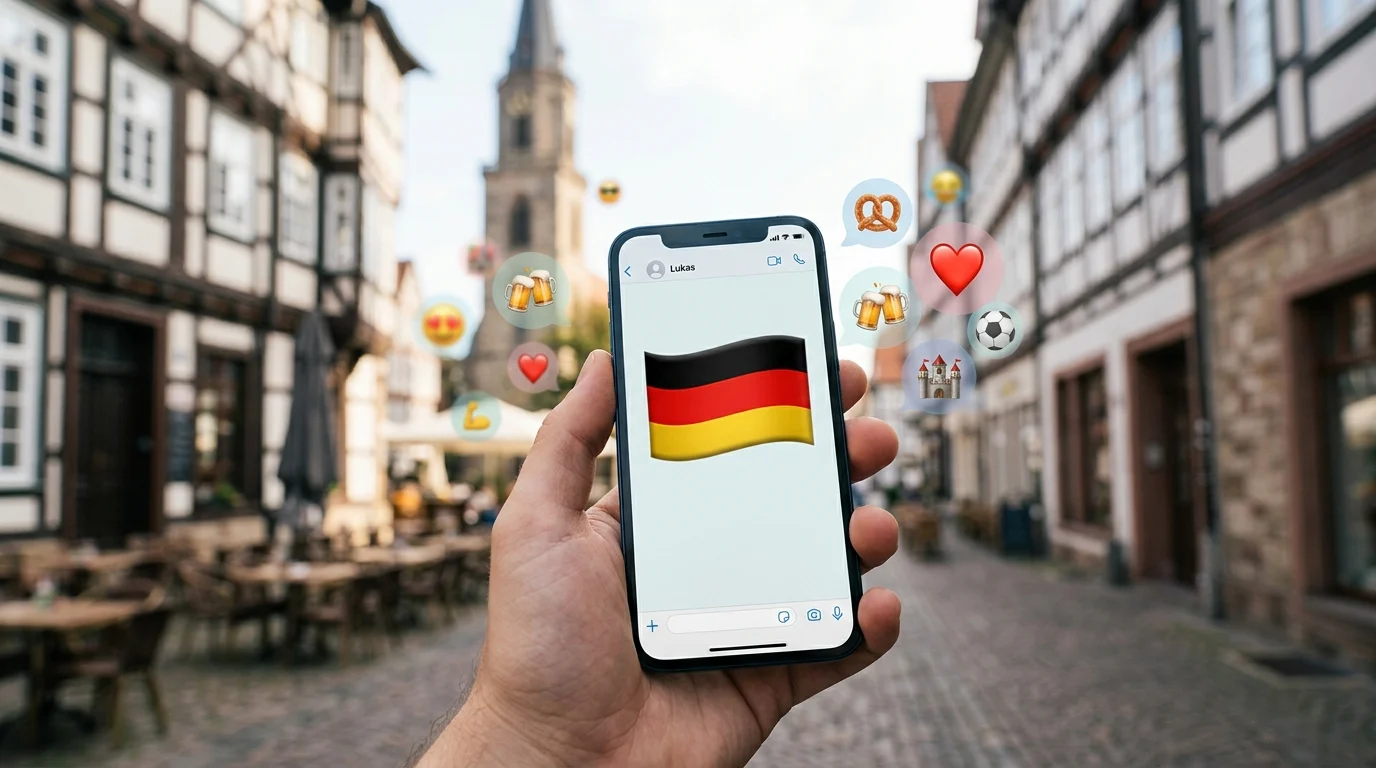
The German emoji 🇩🇪 represents Germany and is commonly used to show German nationality, culture, language, travel, sports, food, or anything connected with the country. It is officially represented as the Germany flag emoji and consists of the regional indicator letters D + E. On supported devices, these two symbols appear together as the German flag. Unicode currently lists 🇩🇪 as the flag of Germany in its Emoji 18.0 charts.
Whether you are posting about a trip to Berlin, supporting Germany in football, learning German, or simply want to add a German touch to a message, 🇩🇪 is the easiest and most recognizable emoji to use.
Quick Answer: What Does the German Emoji 🇩🇪 Mean?
🇩🇪 is the flag emoji for Germany. It usually means Germany, German people, the German language, German culture, or something associated with the country.
You can use it in messages such as:
- “I’m traveling to Germany 🇩🇪”
- “Learning German 🇩🇪”
- “Deutschland! 🇩🇪”
- “German food tonight 🇩🇪🥨”
- “Supporting Germany today 🇩🇪⚽”
The emoji is technically a flag sequence, not a single ordinary emoji character. It combines the Unicode regional indicator symbols for D and E, which correspond to Germany’s two-letter region code.
What Is the German Flag Emoji?
The German flag emoji is:
🇩🇪
It visually represents the national flag of Germany, which has three horizontal bands:
- Black at the top
- Red in the middle
- Gold at the bottom
The emoji is generally shown as a small rectangular flag, although its exact appearance can vary slightly between operating systems, apps, browsers, and emoji vendors.
Unicode itself defines the underlying regional indicator sequence rather than controlling exactly how the flag artwork looks. The Unicode Consortium explains that device and software manufacturers determine the visual design of regional flags.
German Emoji Name
Common names and descriptions include:
- Germany flag emoji
- German flag emoji
- Germany emoji
- Flag of Germany emoji
- 🇩🇪
- Deutschland flag emoji
If someone searches for “German emoji,” they may be looking for 🇩🇪, although the phrase can sometimes refer more broadly to emojis associated with Germany or German culture.
What Does 🇩🇪 Mean in Text Messages?
In texting, 🇩🇪 usually has a straightforward meaning: Germany or something German.
However, its exact meaning depends on the surrounding message.
For example:
| Example | Likely meaning |
| “Going to Germany 🇩🇪” | Traveling to Germany |
| “I love German cars 🇩🇪🚗” | German automobile brands or engineering |
| “Learning German 🇩🇪📚” | Studying the German language |
| “Germany won! 🇩🇪🏆” | Supporting or celebrating a German team |
| “German food 🇩🇪🥨” | German cuisine |
| “Made in Germany 🇩🇪” | German manufacturing or origin |
| “Berlin 🇩🇪” | Berlin, Germany |
| “Deutschland 🇩🇪” | Germany, using its German name |
The emoji can therefore function as a location marker, cultural symbol, nationality reference, or simple visual decoration.
How Does the German Emoji Work?
The technical side of 🇩🇪 is interesting.
Unicode uses regional indicator symbols to create many country flag emoji. Germany is represented by the regional indicators for the letters D and E:
🇩 + 🇪 = 🇩🇪
Unicode’s current documentation explains that regional indicator symbols can be paired to represent territories using their Unicode region subtags. Germany is represented by DE.
The individual regional indicator characters are not normally intended to be used as ordinary letters. When a supported system recognizes a valid pair, it renders the two symbols as a flag.
Unicode’s Emoji 18.0 list identifies the sequence U+1F1E9 U+1F1EA as the flag of Germany.
Is 🇩🇪 One Character?
Not exactly.
What appears to users as one flag emoji is technically a sequence made from two regional indicator symbols.
That is why the German flag can be described as an emoji flag sequence rather than simply one encoded flag character.
This approach is used for many country and regional flags. Unicode currently documents regional indicator symbols as a mechanism for representing flags through pairs of symbols.
When Should You Use the German Emoji 🇩🇪?
There are many natural situations where 🇩🇪 fits.
1. Talking About Germany
The most obvious use is when Germany is the subject of a conversation.
Example:
“Germany is on my travel list 🇩🇪”
2. Talking About the German Language
You can add 🇩🇪 to posts about German vocabulary, grammar, courses, translation, or language learning.
Example:
“New German words learned today 🇩🇪📖”
Remember that 🇩🇪 represents Germany, not the German language itself. It is often used alongside language-related content because German is strongly associated with Germany.
3. Travel and Tourism
Travelers commonly use the emoji when discussing German cities, holidays, landmarks, or transportation.
Examples:
- Berlin 🇩🇪
- Munich 🇩🇪
- Hamburg 🇩🇪
- Frankfurt 🇩🇪
- Road trip through Germany 🇩🇪🚗
- Exploring Germany 🇩🇪✈️
4. Sports
🇩🇪 is particularly useful for international sports.
Fans may combine it with:
- ⚽ Football
- 🏆 Trophy
- 🥇 Gold medal
- 🏃 Athletics
- 🚴 Cycling
For example:
“Come on Germany! 🇩🇪⚽”
The flag can show support for German national teams or athletes representing Germany.
5. German Food
The flag also works in posts about German cuisine.
You might see combinations such as:
- 🇩🇪🥨 German pretzels
- 🇩🇪🌭 German-style sausages
- 🇩🇪🍰 German desserts
- 🇩🇪🍺 German beer
The flag alone does not mean a specific food. The accompanying emoji or text provides the context.
German Emoji Combinations
One of the best things about flag emoji is that they can be combined with other symbols to communicate a more specific idea.
Here are some useful combinations:
| Combination | Possible meaning |
| 🇩🇪⚽ | German football |
| 🇩🇪✈️ | Travel to Germany |
| 🇩🇪🏆 | German victory or championship |
| 🇩🇪📚 | German learning or education |
| 🇩🇪🗣️ | Speaking German |
| 🇩🇪🥨 | German food or culture |
| 🇩🇪🚗 | German cars |
| 🇩🇪🎵 | German music |
| 🇩🇪🏰 | German castles or historic sites |
| 🇩🇪❤️ | Love for Germany |
These combinations are not official meanings. They are contextual interpretations created by users.
German Emoji vs. Other German-Related Symbols
It is easy to confuse a country flag emoji with other symbols associated with Germany.
🇩🇪 German Flag Emoji
🇩🇪 represents Germany and is the standard modern country flag emoji.
🦅 Eagle Symbol
The eagle is strongly associated with German heraldry and national symbolism, but 🦅 is simply the general eagle emoji. It does not specifically mean Germany.
🥨 Pretzel Emoji
🥨 can suggest German food or culture, but pretzels are not exclusively German.
🍺 Beer Emoji
🍺 may be used in connection with German beer culture, but it does not specifically represent Germany.
🏰 Castle Emoji
🏰 can suggest German castles, particularly in travel contexts, but it represents castles generally.
This distinction matters because 🇩🇪 is the direct country identifier, while other emojis only suggest particular aspects of German culture.
Can You Copy and Paste the German Emoji?
Yes. You can copy the German flag directly:
🇩🇪
You can use it in:
- TikTok
- X
- Telegram
- Discord
- Text messages
- Websites
- Online profiles
Whether it displays as a colorful flag depends on the platform, operating system, browser, and font or emoji support.
On a system that does not properly support the sequence, you may see individual regional indicator symbols or another fallback representation instead. Unicode documents these fallback possibilities for unsupported flag sequences.
Why Does the German Emoji Look Different on Different Devices?
Emoji artwork is not identical everywhere.
Apple, Google, Microsoft, Samsung, social media platforms, and other companies can use their own visual designs. Unicode provides the encoded characters and technical standards, while vendors create the artwork displayed to users.
As a result, 🇩🇪 may look slightly different on an iPhone, Android phone, Windows computer, or website.
The important point is that the underlying meaning remains Germany.
Unicode specifically notes that it does not control the designs of regional flag emoji; vendors are responsible for their visual presentation.
When Was the German Flag Emoji Added?
The Germany flag emoji was included in the early development of standardized flag emoji. Emojipedia records Flag: Germany as being added to Emoji 1.0 in 2015.
The underlying regional indicator mechanism is older. Unicode added regional indicator symbols in Unicode 6.0, providing a standardized way to represent country and regional flags through pairs of symbols.
The system has allowed flag emoji to work across different platforms without requiring every country flag to be encoded as a completely separate character.
Common Mistakes When Using 🇩🇪
Although 🇩🇪 is simple, there are a few common misunderstandings.
Mistake 1: Thinking It Means the German Language
🇩🇪 represents Germany, not specifically the German language.
For language-learning content, you can use 🇩🇪 as a visual association, but the surrounding text should make the meaning clear.
Mistake 2: Assuming It Represents Every German-Speaking Region
German is spoken in multiple countries and regions. 🇩🇪 specifically points to Germany.
If your topic concerns Austria, Switzerland, or another German-speaking area, the appropriate regional or national context should be used instead.
Mistake 3: Treating Every German-Themed Emoji as an Official Symbol
🥨, 🍺, 🦅, 🏰, and 🚗 can all be associated with German topics, but none of them means “Germany” in the same direct way as 🇩🇪.
Mistake 4: Assuming Every Device Will Show the Same Design
The appearance can vary by platform. Unicode standardizes the sequence, but vendors control the visual artwork.
Practical Tips for Using the German Emoji
Use 🇩🇪 when the country itself is relevant. It works especially well when you need a quick visual reference without writing “Germany” repeatedly.
For clearer communication:
- Use 🇩🇪 + text when the context could be unclear.
- Pair 🇩🇪 with ⚽ for German football.
- Pair 🇩🇪 with ✈️ for Germany-related travel.
- Pair 🇩🇪 with 📚 for German study.
- Pair 🇩🇪 with 🥨 for German food.
- Avoid assuming 🇩🇪 automatically means the German language.
- Remember that emoji meaning can depend on context and audience.
Unicode also emphasizes that emoji meanings are not completely universal; cultural and conversational context can affect how people interpret them.
FAQs:
1. What is the German flag emoji?
The German flag emoji is 🇩🇪. It represents Germany and is commonly used for German nationality, travel, culture, sports, language-related content, and other Germany-related topics.
2. What does 🇩🇪 mean?
🇩🇪 means Germany or something associated with Germany. Its exact meaning depends on the context in which it is used.
3. How do I copy the German emoji?
Simply copy this symbol: 🇩🇪. You can paste it into social media posts, messages, websites, documents, and other supported applications.
4. Is 🇩🇪 the German language emoji?
No. 🇩🇪 is the flag of Germany. People often use it alongside German-language content, but it technically represents the country rather than the language.
5. Why does the German emoji look different on my phone?
Different platforms use different emoji artwork. Unicode defines the underlying regional indicator sequence, while device and software vendors determine how the flag is visually displayed.
6. What letters make the German flag emoji?
The sequence uses the regional indicator symbols for D and E, corresponding to Germany’s DE region code. Together they are rendered as 🇩🇪 on supported platforms.
7. When was the Germany flag emoji introduced?
The Germany flag emoji was included in Emoji 1.0 in 2015, according to Emojipedia. The regional indicator mechanism used for flag sequences dates back to Unicode 6.0.
8. Can I use 🇩🇪 for German culture?
Yes. 🇩🇪 is often used in posts about German culture, food, travel, music, sports, history, and language. However, the flag specifically identifies Germany, so context is important.
Conclusion
The German emoji 🇩🇪 is the standard flag emoji for Germany and one of the simplest ways to visually identify German-related content. It can represent Germany itself, travel, sports, culture, food, nationality, or conversations connected with the country. Technically, it is created from the regional indicator symbols D and E, which supported platforms render together as the German flag.
For everyday use, simply copy 🇩🇪 and add it wherever Germany is relevant. Whether you are celebrating a German sports victory, planning a trip, studying German, sharing German food, or posting about German culture, the emoji provides a short and recognizable visual cue. Its meaning is straightforward, but the surrounding text and other emojis can make your intended message even clearer.

I am Josiah Michael, an animal enthusiast and writer who loves exploring wildlife, animal behavior, fascinating facts, and unique nicknames while sharing simple, enjoyable knowledge with readers.