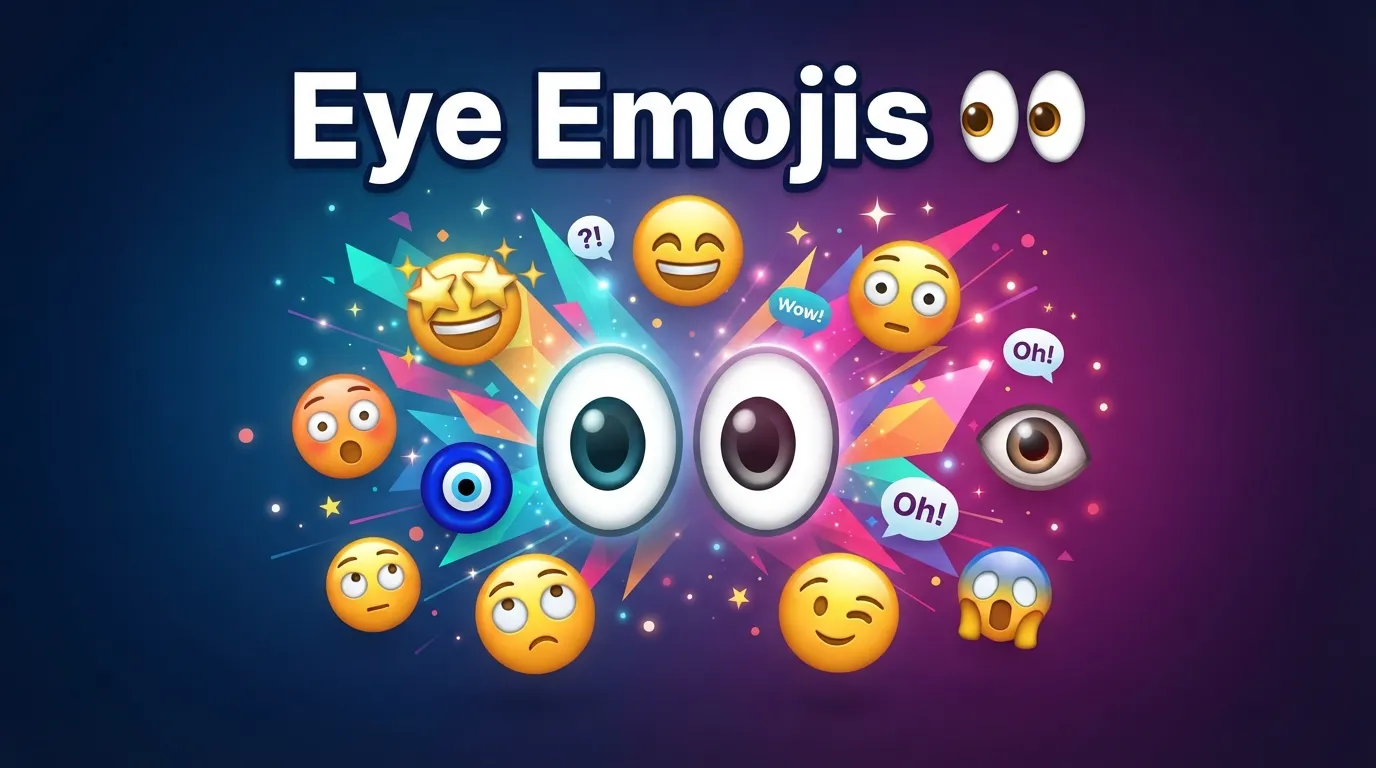
Eye emojis are among the most useful emojis for showing attention, curiosity, surprise, suspicion, attraction, or simply saying “I’m watching.” The most common eye emoji is 👀, but several other eye-related emojis have different meanings and emotional tones.
Understanding these small differences can help you choose the right emoji for texts, social media posts, comments, and online conversations.
Quick Answer: What Do Eye Emojis Mean?
Eye emojis usually represent looking, watching, noticing, paying attention, curiosity, or interest. The 👀 emoji often means “I’m watching,” “I saw that,” “Tell me more,” or “That looks interesting.” Other eye emojis can express a wink, love, crying, tiredness, or a particular facial expression.
The exact meaning depends heavily on the conversation, surrounding words, and relationship between the people communicating.
What Are Eye Emojis?
Eye emojis are symbols based on eyes or facial expressions involving the eyes. They help people communicate feelings and reactions without writing a long sentence.
For example:
- 👀 = I’m watching / I noticed that
- 👁️ = One eye / looking / observing
- 😉 = Wink / playful suggestion
- 😍 = Love or strong admiration
- 😭 = Crying intensely
- 😳 = Embarrassed or shocked
- 🥺 = Pleading or emotional eyes
- 😴 = Sleepy or tired
Among these, 👀 is usually called the “eyes” emoji and is the most direct eye-related symbol.
👀 What Does the Eyes Emoji Mean?
The 👀 emoji generally means “I’m looking,” “I’m watching,” “I noticed,” or “I’m interested.”
However, its meaning can change depending on the situation.
1. Showing That You Are Watching
You can use 👀 when you want to tell someone that you are paying attention.
Example:
“I’m waiting for the results 👀”
Here, 👀 suggests that you are watching carefully and waiting to see what happens.
2. Showing Curiosity
The emoji can mean that something has caught your attention.
Example:
“You got something to tell me? 👀”
This can sound playful and curious.
3. Reacting to Interesting News
People often use 👀 when someone shares surprising, dramatic, or exciting information.
Example:
“Apparently they are getting married 👀”
In this context, the emoji can communicate:
“Oh, really? Interesting…”
4. Suggesting That You Noticed Something
👀 can also mean that you saw something that others may have missed.
Example:
“I saw what you posted 👀”
This can sound playful, teasing, or slightly mysterious.
5. Showing Suspicion
Sometimes 👀 suggests that you are not completely convinced.
Example:
“You said you were sleeping, but you were online 👀”
Here, the emoji gives the sentence a suspicious or teasing tone.
What Does 👁️ Mean?
The 👁️ emoji represents a single eye. It can literally refer to an eye, but it may also represent watching, seeing, observation, or something mysterious.
Compared with 👀, it usually feels more unusual or symbolic.
Examples
“Keep an eye on this 👁️”
“I see everything 👁️”
“Something strange is happening 👁️”
The single-eye emoji can also be used in artistic, mysterious, spiritual, or symbolic contexts.
Eye Emojis and Their Meanings
Different eye-related emojis can communicate very different emotions. Here is a simple comparison:
| Emoji | Common Meaning | Typical Feeling |
| 👀 | Watching, noticing, curiosity | Curious/playful |
| 👁️ | Seeing, observation, one eye | Mysterious/literal |
| 😉 | Wink, teasing, flirting | Playful |
| 😍 | Love, admiration | Romantic/excited |
| 🥺 | Pleading, emotional eyes | Cute/emotional |
| 😳 | Shock, embarrassment | Surprised |
| 😭 | Crying strongly | Very emotional |
| 😴 | Sleepy, tired | Relaxed/tired |
| 🤩 | Excited admiration | Amazed |
| 🙄 | Eye roll, annoyance | Irritated |
| 😏 | Smirking, confidence | Suggestive/playful |
| 🤪 | Silly or confused reaction | Goofy |
This shows why context matters. An emoji containing eyes does not necessarily mean the same thing as 👀.
Why Do People Use 👀 So Often?
The eyes emoji is popular because it can communicate several ideas without needing many words.
For example, instead of saying:
“That information is very interesting, and I want to know more about it.”
Someone might simply reply:
👀
The short response can communicate curiosity immediately.
It is especially common in:
- Text messages
- Group chats
- Social media comments
- Dating conversations
- Memes
- Online discussions
- Reaction posts
- Friendly teasing
- Celebrity or entertainment discussions
👀 Emoji Meaning in Text Messages
The meaning of 👀 can change depending on the message before it.
Example 1: Curiosity
Person A: “Guess who I saw today?”
Person B: “👀”
Meaning: “Who? Tell me!”
Example 2: Suspicion
Person A: “I definitely didn’t eat the last cookie.”
Person B: “👀”
Meaning: “Hmm, I don’t believe you.”
Example 3: Interest
Person A: “There’s a new restaurant downtown.”
Person B: “👀”
Meaning: “That sounds interesting.”
Example 4: Teasing
Person A: “I think someone has a crush.”
Person B: “👀”
Meaning: “Oh really? Tell me more.”
What Does 👀 Mean From a Girl or Guy?
There is no single meaning based on whether the sender is a girl or a guy.
The same 👀 emoji can mean curiosity, attention, teasing, suspicion, attraction, or interest depending on the conversation.
For example:
“You look good today 👀”
This may sound flirtatious.
But:
“The teacher is coming 👀”
usually means that the person is alerting you that someone is approaching.
So, do not assume 👀 is automatically flirting.
Look at the surrounding words and the existing relationship between the people.
Does 👀 Mean Flirting?
Sometimes, yes.
The 👀 emoji can have a flirtatious meaning when it appears alongside compliments, romantic messages, or suggestive comments.
For example:
“You really posted that picture? 👀”
Depending on the relationship, this could be playful or flirtatious.
Another example:
“You’re looking amazing tonight 👀”
Here, 👀 can add a teasing or attractive tone.
However, using 👀 by itself does not prove romantic interest.
Context is important.
👀 vs 👁️: What Is the Difference?
Although both emojis represent eyes, they have different visual and conversational styles.
| Feature | 👀 | 👁️ |
| Appearance | Two eyes | One eye |
| Main idea | Watching or noticing | Seeing or observing |
| Tone | Casual | Symbolic or unusual |
| Common in texting | Very common | Less common |
| Can suggest curiosity | Yes | Sometimes |
| Can suggest mystery | Sometimes | Often |
If you want a natural reaction in a chat, 👀 is usually the better choice.
If you want a symbolic, artistic, or unusual feeling, 👁️ may work better.
How to Use Eye Emojis Naturally
Using emojis effectively is mostly about matching the emoji to the situation.
Use 👀 When You Want to Say:
- “I’m watching.”
- “I noticed that.”
- “That is interesting.”
- “Tell me more.”
- “What’s going on?”
- “I’m suspicious.”
- “I saw that.”
- “I’m paying attention.”
Examples
For curiosity:
“What happened next? 👀”
For gossip:
“Wait, they broke up? 👀”
For teasing:
“Someone is looking fancy today 👀”
For suspicion:
“You said you weren’t online 👀”
For excitement:
“The new episode is finally out 👀”
Eye Emojis on Social Media
Eye emojis are especially useful in social media comments because they can create a quick reaction without requiring a complete sentence.
For example:
“This outfit 👀🔥”
This can communicate strong admiration or interest.
Another example:
“Okay, I see you 👀”
This can sound approving, teasing, or playful.
On social platforms, emojis can also make a comment feel more energetic and conversational.
Common Mistakes When Using Eye Emojis
Even though eye emojis are simple, they can sometimes be misunderstood.
Mistake 1: Assuming 👀 Always Means Flirting
It does not.
Someone may use 👀 simply because they are curious or surprised.
Mistake 2: Ignoring the Context
An emoji cannot always be understood alone.
For example:
“The boss is here 👀”
means something very different from:
“You look amazing 👀”
Mistake 3: Overusing 👀
Using several eye emojis in every message can make your writing feel repetitive.
One emoji is often enough.
Mistake 4: Using a Serious Emoji in a Serious Message
Emojis can make serious messages sound less formal.
For professional communication, consider whether the emoji is appropriate before using it.
Mistake 5: Thinking Emoji Meanings Are Universal
People can interpret emojis differently because of age, culture, relationships, and personal communication styles.
Practical Tips for Choosing the Right Eye Emoji
If you are unsure which emoji to use, think about the emotion you want to communicate.
Want to show curiosity?
Use 👀.
Want to show one eye or observation?
Use 👁️.
Want to tease someone?
Try 😉 or 👀.
Want to show admiration?
Try 😍 or 🤩.
Want to show embarrassment or shock?
Try 😳.
Want to show pleading or emotional eyes?
Try 🥺.
Want to show annoyance?
Try 🙄.
The best emoji is the one that matches the feeling behind your message.
Frequently Asked Questions
1. What does 👀 mean in texting?
👀 usually means “I’m watching,” “I noticed,” “I’m curious,” or “Tell me more.” Its exact meaning depends on the conversation.
2. What does 👀 mean from a girl?
It can mean curiosity, teasing, attention, suspicion, or flirting. The emoji alone does not reveal exactly what she means.
3. What does 👀 mean from a guy?
It can mean that he noticed something, is interested, is curious, or is joking around. Context determines the meaning.
4. Is 👀 a flirty emoji?
It can be flirty in romantic or suggestive conversations, but it is not automatically a flirting emoji.
5. What does 👁️ mean?
👁️ represents a single eye and can mean seeing, watching, observation, mystery, or simply an eye.
6. What does 👀 mean on social media?
On social media, 👀 commonly shows interest, curiosity, surprise, admiration, or that someone noticed something interesting.
7. Can 👀 mean “I see you”?
Yes. Depending on the context, 👀 can communicate “I see you,” “I noticed that,” or “I’m watching.”
8. What is the difference between 👀 and 👁️?
👀 shows two eyes and is commonly used for casual reactions, curiosity, and watching. 👁️ shows one eye and is more literal, symbolic, or mysterious.
Conclusion
Eye emojis are small but powerful communication tools. The most common one, 👀, can express curiosity, attention, surprise, suspicion, interest, or playful teasing. Other eye-related emojis, such as 👁️, 😉, 😍, 🥺, and 🙄, communicate different emotions and should be selected according to the situation.
The most important thing to remember is that context determines meaning. An 👀 reply can be innocent curiosity in one conversation and playful flirting in another. Pay attention to the words around the emoji, your relationship with the sender, and the overall tone of the conversation. When used naturally, eye emojis can make digital conversations clearer, more expressive, and more fun.

I am Caleb James, Administrator at AnimalsBuz. I love animals and enjoy sharing interesting facts, unique animal nicknames, and helpful information that makes learning about wildlife fun and engaging.