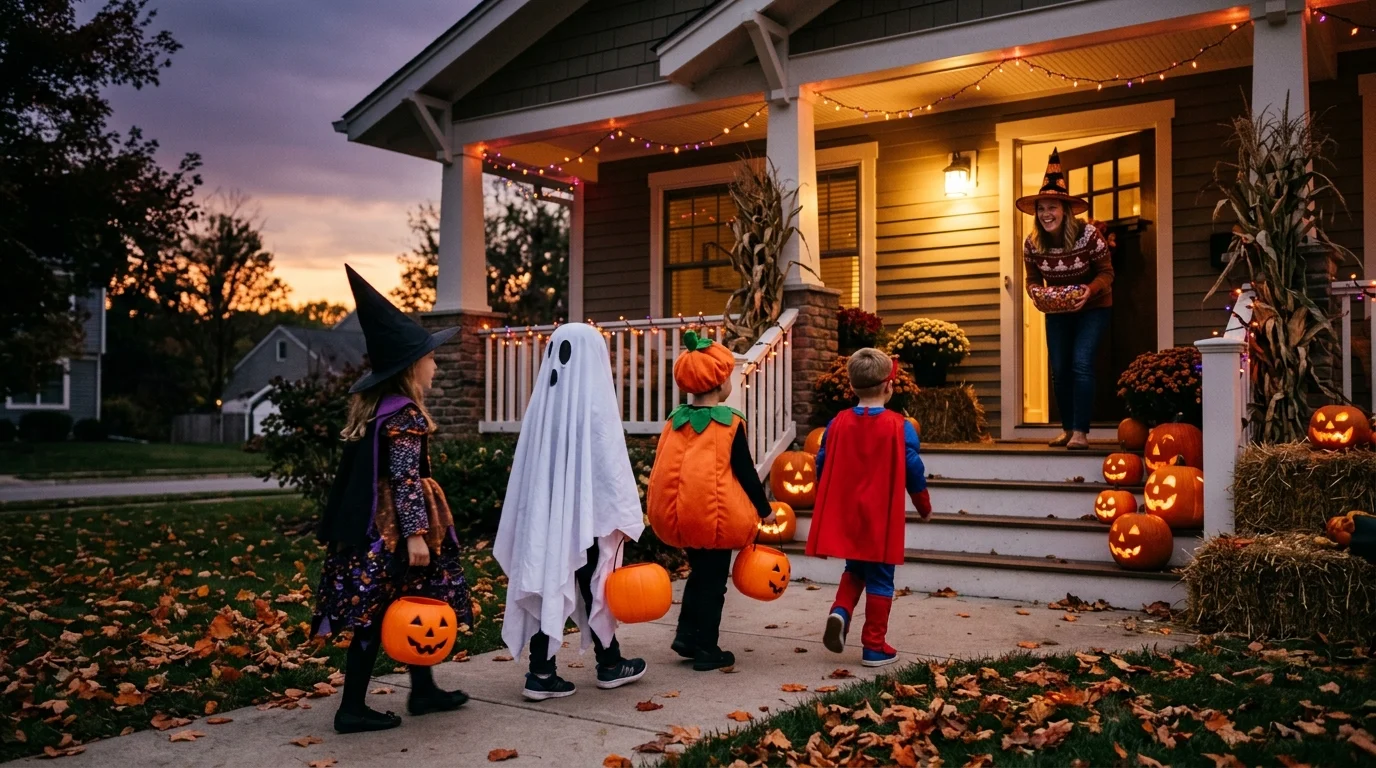
Trick-or-treating does not have one official start time. Most neighborhoods in the United States start around 5:00 or 6:00 p.m. and finish by 8:00 or 9:00 p.m. on October 31. This year, Halloween falls on Saturday, October 31, 2026, so many families will have extra time to enjoy the evening.
The exact hours depend on where you live. Some towns announce a set window, such as 6:00 to 8:00 p.m. Others pick a different evening, and some leave it up to families. In this guide, you will learn the usual hours, how to find your local time, and how to stay safe. You will also see the difference between trick-or-treating and trunk-or-treat, plus easy examples and answers to common questions.
Quick Answer: What Time Is Trick-or-Treating?
Trick-or-treating usually runs from about 5:00 p.m. to 9:00 p.m. on Halloween night, October 31. Younger children often go out earlier, around 5:00 to 7:00 p.m., while older kids stay out later. Because each town sets its own hours, check your city website or neighborhood group for the exact times.
Why Do People Get Confused About Trick-or-Treating Times?
There is no national rule. Each city, town, or neighborhood decides what works best. That is why you may hear different answers from different people.
Here are the most common reasons for confusion:
- Some towns post official hours, and others do not.
- Some places hold trick-or-treating on a different night than October 31.
- Schools, malls, and churches often hold their own events at different times.
- Sunset changes by location, so “when it gets dark” is not the same everywhere.
- Friends and family may remember hours from when they were children.
Trick-or-Treating: The Traditional Neighborhood Activity
Trick-or-treating is when children dress in costumes and go from house to house asking for candy. They say “Trick or treat!” at the door. A porch light that is on usually means the home welcomes visitors.
This activity happens outdoors in neighborhoods. Because of that, the time often depends on daylight, weather, and local advice.
- Typical start: 5:00 to 6:00 p.m.
- Typical end: 8:00 to 9:00 p.m.
- Best for: families who want a classic Halloween night
- Where it happens: streets and neighborhoods
Trunk-or-Treat: The Organized Event
Trunk-or-treat is a special event, often held in a parking lot at a school, church, or community center. Adults park their cars, decorate the trunks, and give out candy from them. Children walk from car to car.
These events often start earlier and may have a fixed end time. They also may happen on a different day, sometimes before October 31.
- Typical hours: often late afternoon or early evening, and the event usually posts them
- Best for: very young children and families who want a controlled space
- Where it happens: one parking lot or a community space
Trick-or-Treating vs. Trunk-or-Treat: Comparison Table
| Feature | Trick-or-Treating | Trunk-or-Treat |
| Location | Neighborhood streets | Parking lot or event space |
| Usual time | About 5:00–9:00 p.m. | Set by the event organizer |
| Date | Usually October 31 | Often October 31 or a nearby day |
| Who runs it | Neighbors and the community | Schools, churches, or groups |
| Walking distance | Longer, house to house | Short, car to car |
| Where to find times | City website or local group | Event flyer or website |
When to Use Each Option
Choose traditional trick-or-treating if you like walking around and seeing neighborhood decorations. It works well for older children and families who live in a safe, active area.
Choose trunk-or-treat if you have toddlers, if your area has few houses, or if the weather is bad. It is also helpful if you want a clear start and end time.
You can also do both. Many families go to an early trunk-or-treat and then walk their street for an hour.
Examples You Can Use
These sentences show how people talk about trick-or-treating times:
- “What time does trick-or-treating start in our town?”
- “Our neighborhood trick-or-treating runs from 6:00 to 8:00 p.m.”
- “We take the little kids out at 5:30 and come home by 7:00.”
- “The city says trick-or-treating ends at 9:00 p.m.”
- “Is trick-or-treating on Saturday, October 31, this year?”
- “The church trunk-or-treat starts at 5:00 p.m. in the parking lot.”
- “Turn on your porch light if you want trick-or-treaters to visit.”
- “Teenagers usually go out later, after the younger children are home.”
- “My town holds trick-or-treating on a different night than Halloween.”
- “We always check the local news for the official hours.”
- “It gets dark early, so bring a flashlight.”
- “The mall offers indoor trick-or-treating during the afternoon.”
Common Mistakes to Avoid
- Assuming one time fits every place. Always check your local hours.
- Waiting too late. Many families put away their candy by 8:00 or 9:00 p.m.
- Forgetting about sunset. It may be dark earlier than you expect.
- Confusing trunk-or-treat with trick-or-treating. They are different events with different times.
- Ignoring the weather. Rain or cold can change local plans.
- Not checking the date. Some towns choose a different evening.
Memory Trick
Remember “5 to 9, check the line.” Most trick-or-treating happens between 5 and 9 p.m., and “the line” means the local announcement or schedule. If you are unsure, look it up before you go.
American vs. British English
In the United States, “trick-or-treating” is the common name, and hours are often set by towns. The activity is very popular, and many neighborhoods are busy from early evening.
In the United Kingdom, “trick or treating” is also used, but it is less formal and often starts right after dark. Clocks go back on October 25, 2026, so it can get dark before 5:00 p.m. Many families go out early. In Scotland, some children go “guising,” which means performing a song, joke, or poem for a treat. Also, British speakers often say “sweets” instead of “candy.”
Similar Words and Related Terms
- Halloween: the holiday on October 31
- Trunk-or-treat: a parking-lot candy event
- Guising: a Scottish tradition of performing for treats
- Beggars’ Night: a local name for trick-or-treating in some parts of the United States
- Costume party: a Halloween gathering that is not door to door
- Treat bag: the bag or bucket used to hold candy
Final Verdict
If you need a simple answer, plan for 5:00 to 9:00 p.m. on October 31. Little children are usually done by 7:00 or 8:00 p.m., and older kids may stay out until closer to 9:00. Always check your local hours first, because towns can change them.
FAQs:
What time does trick-or-treating usually start?
Most areas start between 5:00 and 6:00 p.m. Some start earlier in the late afternoon, especially for young children.
What time does trick-or-treating usually end?
It usually ends between 8:00 and 9:00 p.m. Some towns set an official end time, and families often stop earlier.
Is trick-or-treating on Halloween night?
Usually yes. In 2026, Halloween is Saturday, October 31. A few towns choose a different night, so check your local announcement.
How do I find my town’s trick-or-treating hours?
Look at your city or town website, local news, or neighborhood group. Police and fire department pages sometimes post the hours too.
Is it too late to go trick-or-treating at 9:00 p.m.?
In many places, yes. Most families finish earlier, and many people turn off porch lights by 8:00 or 9:00 p.m.
What is the best time to take young children trick-or-treating?
Early evening, around 5:00 to 7:00 p.m., is often best. It is lighter, more houses are open, and it is easier to get home for bedtime.
What age is too old for trick-or-treating?
There is no universal age. Some towns set a limit, but many families use common sense and politeness. Older kids should go later, be respectful, and wear a costume.
How do I know if a house welcomes trick-or-treaters?
A lit porch light, decorations, or a bowl of candy outside usually means yes. If the light is off, skip the house.
Remember This
- Most trick-or-treating runs from about 5:00 to 9:00 p.m.
- Halloween 2026 falls on Saturday, October 31.
- Hours differ by town, so check local information.
- Trunk-or-treat is a separate event with its own time.
- Go early with young children, and use a flashlight.
Conclusion
Trick-or-treating times are simple once you know the pattern. Most families go out in the early evening, finish by about 9:00 p.m., and look for houses with porch lights on. Because every town is a little different, a quick check of your local website or neighborhood group saves time and confusion.
Whether you choose a classic walk through your neighborhood or a trunk-or-treat event, plan ahead, stay safe, and enjoy the night. Wear something bright, carry a light, and stay with a trusted adult if you are young. A little planning makes Halloween fun for everyone.

I am Josiah Michael, an animal enthusiast and writer who loves exploring wildlife, animal behavior, fascinating facts, and unique nicknames while sharing simple, enjoyable knowledge with readers.