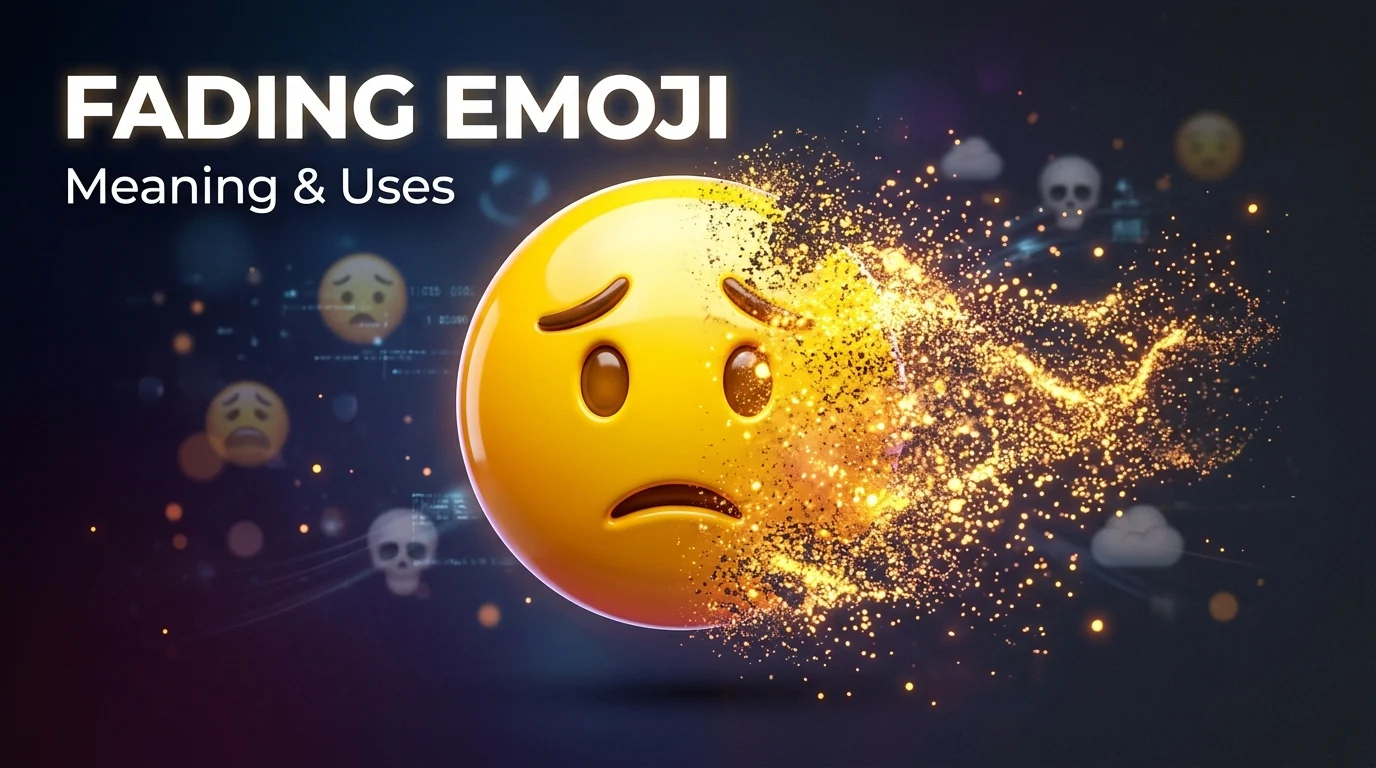
The fading emoji is commonly used to express feelings of disappearing, becoming less noticeable, losing energy, feeling emotionally distant, or slowly withdrawing from a situation. Depending on the conversation, it can communicate awkwardness, embarrassment, exhaustion, sadness, uncertainty, or the desire to quietly disappear. Its meaning often depends on the surrounding words and the relationship between the people using it.
Because emoji meanings can change with context, the fading emoji does not always have one fixed interpretation. Someone might use it jokingly after making an embarrassing mistake, while another person may use it to describe feeling ignored or emotionally drained. Understanding the conversation around the emoji is therefore important.
Quick Answer: What Does the Fading Emoji Mean?
The fading emoji generally represents slowly disappearing, fading away, becoming less visible, losing confidence, or wanting to retreat from a situation.
People may use it when they feel:
- Embarrassed or awkward
- Socially uncomfortable
- Emotionally drained
- Ignored or forgotten
- Shy or uncertain
- Like disappearing from a conversation
- Less important or less noticeable
- Overwhelmed and ready to withdraw
Its exact meaning depends on the message, tone, and situation.
What Is the Fading Emoji?
The term “fading emoji” is often used informally to describe an emoji that visually suggests someone or something becoming less visible or disappearing.
In everyday conversations, people may use the phrase to describe an emoji that communicates a sense of vanishing, fading into the background, or quietly escaping a situation.
The visual idea behind this type of emoji is easy to understand. Instead of showing a strong emotional reaction such as laughing, crying, or anger, it suggests a more subtle reaction: “I am slowly disappearing from this situation.”
That makes it particularly useful in casual digital conversations.
What Does the Fading Emoji Symbolize?
The fading emoji can symbolize several related ideas.
1. Wanting to Disappear
One of the most common interpretations is the feeling of wanting to disappear because a situation has become embarrassing or uncomfortable.
For example:
“I accidentally sent the message to the wrong group. 🫥”
The emoji can communicate:
“I wish I could disappear right now.”
2. Feeling Awkward
The emoji can also express an awkward reaction when someone does not know what to say.
For example:
“Everyone started arguing and I was just sitting there. 🫥”
Here, it can mean:
“I don’t know what to do in this situation.”
3. Emotional Withdrawal
In a more serious conversation, fading can represent emotional distance or withdrawal.
For example:
“I have not felt like talking to anyone lately.”
Adding a fading-style emoji can reinforce the idea of quietly pulling away from social interaction.
4. Feeling Forgotten
The emoji may sometimes represent the feeling of becoming unnoticed.
For example:
“They planned everything and forgot to invite me. 🫥”
In this context, it can suggest feeling invisible or left out.
5. Exhaustion
A person may also use a fading emoji after a tiring day.
For example:
“Three meetings, two exams, and no sleep. 🫥”
Here, the meaning is closer to:
“I have no energy left.”
Fading Emoji Meaning in Different Situations
The same emoji can communicate different emotions depending on the conversation.
| Situation | Possible Meaning |
| Embarrassing moment | “I want to disappear.” |
| Awkward conversation | “I don’t know what to say.” |
| Long workday | “I’m completely exhausted.” |
| Being ignored | “I feel invisible.” |
| Social situation | “I’m quietly withdrawing.” |
| Bad news | “This is emotionally draining.” |
| Funny mistake | “That was embarrassing!” |
| Relationship conversation | “I’m becoming emotionally distant.” |
This flexibility is one reason fading-style emojis are popular in casual messaging.
Fading Emoji vs. Other Similar Emojis
The fading emoji can sometimes be confused with other emojis that express embarrassment, invisibility, silence, or exhaustion.
Fading Emoji vs. Disappearing or Invisible Emojis
A disappearing or invisible-style emoji generally focuses on not being seen.
The fading emoji can add an emotional meaning such as:
- Feeling uncomfortable
- Slowly withdrawing
- Losing confidence
- Wanting to escape
The difference is subtle, so the surrounding message matters.
Fading Emoji vs. Embarrassed Emoji
An embarrassed emoji usually communicates a clear emotional reaction to an uncomfortable situation.
A fading emoji can communicate something quieter:
“I am so embarrassed that I want to disappear.”
Fading Emoji vs. Sad Emoji
A sad emoji directly communicates sadness.
A fading emoji is more indirect. It may suggest:
- Emotional exhaustion
- Loneliness
- Withdrawal
- Feeling unnoticed
- Wanting space
Therefore, it can sometimes feel more understated than a traditional sad emoji.
Fading Emoji vs. Tired Emoji
A tired emoji normally indicates physical or mental tiredness.
A fading emoji can suggest something broader, such as:
“I am mentally done with everything.”
How to Use the Fading Emoji in Text Messages
The fading emoji works especially well when the words already establish the context.
Here are several natural examples.
After an Embarrassing Mistake
“I called my teacher ‘Mom’ in front of everyone. 🫥”
Meaning: I want to disappear from embarrassment.
During an Awkward Conversation
“He asked me why I was still single. 🫥”
Meaning: That question made me extremely uncomfortable.
After a Long Day
“I have been working since 7 AM. 🫥”
Meaning: I have almost no energy left.
When Feeling Ignored
“Everyone was talking, and nobody noticed I was there. 🫥”
Meaning: I felt invisible.
In a Funny Situation
“I waved back at someone who wasn’t waving at me. 🫥”
Meaning: That was painfully awkward.
Fading Emoji Meaning in Social Media
On social media, emoji meanings can become more playful.
A person might add a fading emoji to a post or comment after making a small mistake, experiencing an awkward moment, or sharing something embarrassing.
For example:
“Posted the picture and immediately noticed the typo. 🫥”
The emoji adds emotional tone without requiring a long explanation.
It can also make a serious-looking sentence feel humorous.
For example:
“I have officially run out of social energy. 🫥”
This usually sounds more playful than simply saying, “I am socially exhausted.”
Fading Emoji Meaning in Relationships
The meaning can become more sensitive when used between romantic partners or close friends.
For example:
“You haven’t replied all day. 🫥”
This could suggest feeling ignored or emotionally distant.
However, it does not automatically mean that the person wants to end the relationship. That interpretation would require additional context.
Similarly:
“I don’t know what to say anymore. 🫥”
could indicate frustration, sadness, awkwardness, or emotional exhaustion.
The best way to understand it is to consider the person’s complete message rather than interpreting the emoji alone.
Is the Fading Emoji Negative?
Not necessarily.
The fading emoji can be:
- Funny
- Playful
- Embarrassed
- Awkward
- Sad
- Tired
- Emotionally distant
- Self-deprecating
Its emotional tone depends heavily on context.
For example:
“I ate the entire pizza by myself. 🫥”
This may be humorous.
But:
“Nobody has talked to me all week. 🫥”
could communicate genuine loneliness.
The same visual symbol can therefore have very different emotional meanings.
Common Fading Emoji Mistakes
Using It Without Context
If you simply send a fading emoji without any other message, the recipient may not understand what you mean.
They might interpret it as sadness, embarrassment, tiredness, or confusion.
Assuming Everyone Interprets It the Same Way
Emoji meanings are not universal rules. Different people and age groups may use the same emoji differently.
Using It in a Serious Message Without Explanation
If you are discussing an important personal issue, relying only on an emoji can create confusion.
For serious conversations, words are usually better for explaining what you actually feel.
Overusing It
Using the same emoji repeatedly can reduce its impact.
For example:
“I’m tired 🫥🫥🫥🫥🫥”
may look more dramatic or humorous than intended.
One emoji is often enough.
Practical Tips for Using the Fading Emoji
If you want your message to be understood clearly, follow these simple tips:
- Use context. Add words that explain what happened.
- Consider your audience. Friends may understand playful emoji use better than professional contacts.
- Use it for subtle emotions. It works well for awkwardness, withdrawal, and wanting to disappear.
- Do not rely on it for serious communication. Explain important feelings with words.
- Match the tone. A humorous sentence can make the emoji feel playful.
- Avoid overuse. One well-placed emoji is usually more effective.
- Remember that interpretation varies. Your recipient may understand it differently.
Fading Emoji Examples for Everyday Conversations
Here are some ready-to-use examples:
Embarrassment:
“I just realized I was talking to the wrong person. 🫥”
Awkwardness:
“Nobody said anything after my joke. 🫥”
Exhaustion:
“Work completely destroyed me today. 🫥”
Social withdrawal:
“I think I’m going to stay home tonight. 🫥”
Feeling invisible:
“I was standing right there and nobody noticed me. 🫥”
Funny mistake:
“I sent the screenshot to the person I was talking about. 🫥”
Overwhelmed:
“Five deadlines in one week. I’m fading. 🫥”
Embarrassing memory:
“Why did I say that three years ago? 🫥”
Frequently Asked Questions
1. What does the fading emoji mean?
The fading emoji generally suggests disappearing, feeling invisible, becoming emotionally distant, feeling awkward, or wanting to quietly escape a situation. The exact meaning depends on context.
2. Does the fading emoji mean sadness?
It can express sadness, but sadness is not its only meaning. It may also represent embarrassment, awkwardness, exhaustion, social withdrawal, or feeling unnoticed.
3. Can the fading emoji be used as a joke?
Yes. It is commonly suitable for humorous or embarrassing situations, especially when someone wants to express, “I wish I could disappear.”
4. What does the fading emoji mean from a friend?
A friend might use it to show embarrassment, awkwardness, tiredness, or a desire to withdraw from a situation. Look at the rest of the conversation before deciding what they mean.
5. What does the fading emoji mean in texting?
In texting, it often adds an emotional reaction to a sentence. It can communicate “I’m disappearing,” “I’m uncomfortable,” “I’m exhausted,” or “I don’t know what to say.”
6. Is the fading emoji romantic?
Not necessarily. It does not have a specific romantic meaning. In a relationship conversation, however, it can express emotional distance, awkwardness, or feeling ignored.
7. Is the fading emoji positive or negative?
It can be either. In a funny conversation it may be playful, while in a serious conversation it may express loneliness, exhaustion, or emotional withdrawal.
8. Can I use the fading emoji professionally?
It depends on the workplace and the relationship. In formal communication, clear words are usually safer. In a relaxed team chat, it may be appropriate if emoji use is already common.
Conclusion
The fading emoji is a flexible way to communicate the feeling of slowly disappearing, becoming invisible, feeling awkward, losing social energy, or wanting to escape a situation. Its meaning is not limited to sadness. It can be humorous, embarrassed, tired, uncomfortable, or emotionally distant depending on the conversation.
The most important thing is context. A fading emoji after a funny mistake can mean “I want to disappear,” while the same emoji during a serious conversation may suggest emotional withdrawal or feeling unnoticed. When the meaning matters, combine the emoji with clear words so the other person understands exactly what you are trying to say.

I am Emma Rose, an animal enthusiast and writer passionate about exploring animals, their unique traits, behaviors, and creative nicknames while sharing simple, engaging, and informative content with readers.