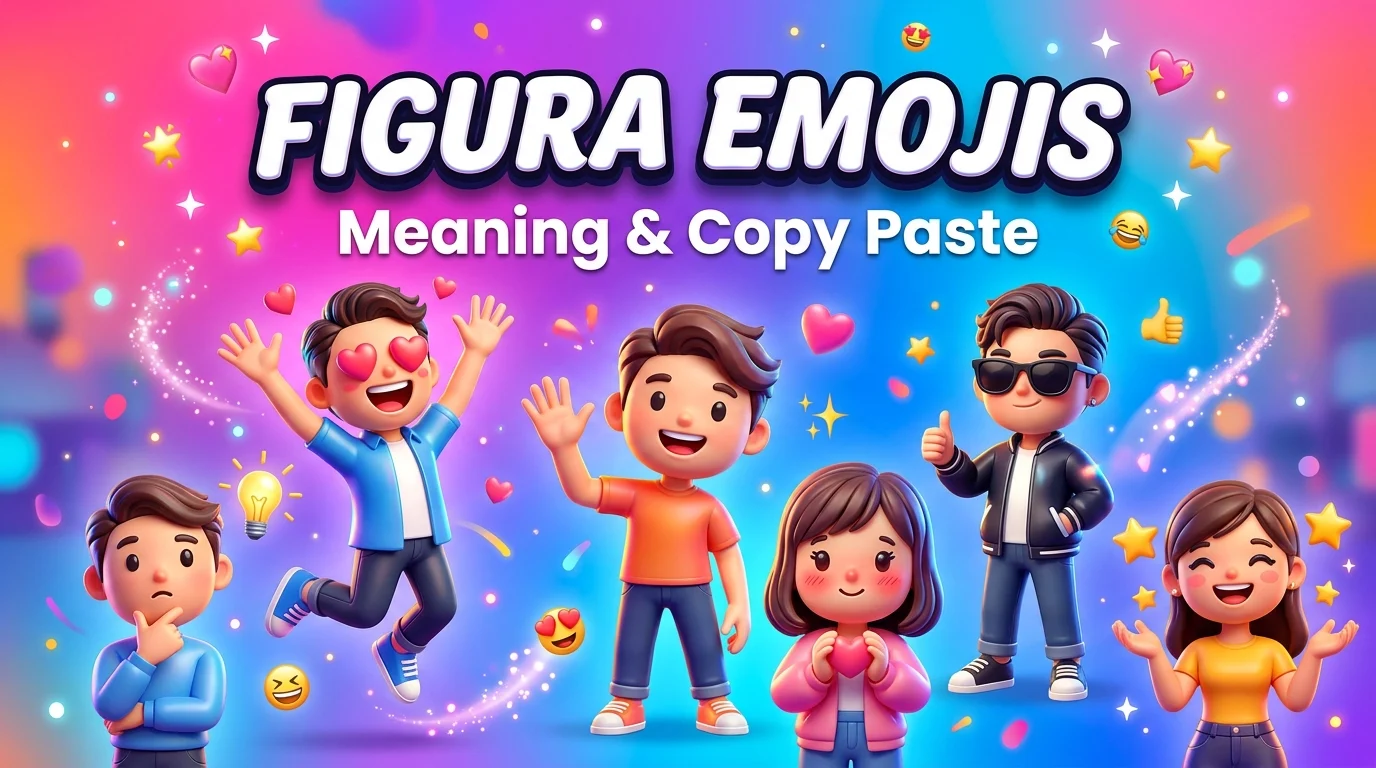
Figura emojis generally refers to emojis and symbols that represent people, human figures, body positions, gestures, characters, or visual figures. They can show actions such as walking, running, dancing, sitting, waving, thinking, celebrating, or simply standing. Because the phrase “figura emojis” can be used broadly, it may also refer to figure-shaped symbols, person emojis, stick figures, or character-style emoji combinations.
These emojis are useful because they add human expression to digital conversations without requiring long explanations. A small figure can communicate movement, emotion, identity, activity, or a reaction almost instantly. In this guide, you will learn what figura emojis mean, how to use them, common examples, differences between related symbols, and practical ways to combine them.
Quick Answer
Figura emojis are emojis or emoji-style symbols that represent human figures, people, body movements, poses, or characters. Examples include walking, running, dancing, waving, raising hands, bowing, thinking, shrugging, and other person-related emojis.
They can be used in text messages, social media captions, comments, usernames, profiles, invitations, stories, and creative posts. The exact meaning depends on the emoji and the surrounding context.
What Are Figura Emojis?
The word figura can mean “figure” or “shape” in several languages, so “figura emojis” is not the name of one official emoji category.
Online, people may use the phrase to describe emojis that visually represent a person or human figure. These include full-body emojis, people performing activities, gestures, silhouettes, and character-like symbols.
For example, person-related emojis can communicate:
- Movement
- Emotion
- Celebration
- Communication
- Exercise
- Work
- Travel
- Social interaction
- Greetings
- Reactions
- Body language
Instead of writing “I am running,” someone can use a running-person emoji to make the message shorter and more visual.
Why Are Figure Emojis So Popular?
Human figures are among the easiest visual symbols to understand.
A person raising their hands can suggest celebration or excitement. Someone running can represent exercise, urgency, or leaving quickly. A person waving can communicate hello or goodbye.
This makes figure emojis useful in situations where a few characters can replace an entire phrase.
They are especially common in:
- Text messages
- Social media
- Chat applications
- Online communities
- Digital invitations
- Captions
- Comments
- Personal profiles
- Informal announcements
Figure emojis also make plain text more expressive. A simple sentence can feel more energetic when paired with an appropriate visual symbol.
Types of Figura Emojis
Figura emojis can be grouped into several broad categories.
1. Standing and Basic Person Emojis
These represent people without necessarily showing a specific action.
They can be useful when discussing people, groups, identity, or human activity.
2. Walking and Running Emojis
Movement emojis can represent walking, running, exercise, escaping, traveling, or rushing somewhere.
Their meaning depends heavily on context.
For example:
“Running late 🏃”
Here, the figure communicates urgency.
In another context:
“Morning workout 🏃”
The same type of figure represents exercise.
3. Dancing and Celebrating Figures
Dancing figures are often associated with:
- Happiness
- Parties
- Music
- Celebration
- Excitement
- Having fun
They are common in social media captions and informal messages.
4. Gesture Emojis
Hand and body gestures are another major group of figure-related emojis.
Examples include gestures that communicate:
- Hello
- Goodbye
- Approval
- Disapproval
- Agreement
- Gratitude
- Celebration
- Surprise
- Respect
These symbols often function like visual body language.
5. Thinking and Emotional Figures
Some emojis show people in emotional or reflective poses.
They can represent:
- Thinking
- Confusion
- Sadness
- Frustration
- Relief
- Surprise
- Excitement
- Embarrassment
The surrounding text helps determine the intended interpretation.
Common Figura Emoji Examples
Here are examples of figure-related emojis and their common uses:
| Emoji | Common meaning | Example use |
| 🧍 | Standing person | “Just standing here 🧍” |
| 🚶 | Walking | “Going for a walk 🚶” |
| 🏃 | Running | “I’m late! 🏃” |
| 💃 | Dancing | “Party time 💃” |
| 🕺 | Dancing | “Let’s celebrate 🕺” |
| 🙋 | Raising hand | “I know the answer 🙋” |
| 🙆 | OK or acceptance | “Everything is fine 🙆” |
| 🤷 | Uncertainty or shrugging | “I don’t know 🤷” |
| 🤦 | Frustration or disbelief | “I forgot again 🤦” |
| 🙏 | Thanks, prayer, or request | “Thank you 🙏” |
| 👋 | Waving | “Goodbye 👋” |
| 🫶 | Affection or support | “Sending love 🫶” |
These meanings are common rather than absolute. Context can change how an emoji is understood.
How Do Figura Emojis Change the Meaning of a Message?
An emoji can change the emotional tone of a sentence without changing the words.
Compare:
“Okay.”
with:
“Okay 🙆”
The second version may feel more positive or reassuring.
Likewise:
“I forgot.”
can become:
“I forgot 🤦”
The figure adds frustration, embarrassment, or humor.
This is why figure emojis are often considered a form of digital body language.
Figura Emojis and Body Language
Face-to-face conversations contain many visual signals that disappear when people communicate through text.
A person can use facial expressions, hand movements, posture, and gestures to show what they mean.
Emojis help recreate some of those signals.
For example:
- 👋 can function like a wave.
- 🙏 can communicate thanks or a request.
- 🤷 can represent a shrug.
- 🤦 can show frustration.
- 🫶 can communicate affection or support.
- 🙌 can express celebration.
These symbols do not perfectly reproduce real-world body language, but they provide useful visual context.
Figure Emojis for Social Media
Figure emojis work particularly well in social media captions because they can make short text more expressive.
For example:
“Weekend mode 💃✨”
“Heading home 🚶”
“We did it! 🙌”
“Trying to stay positive 🫶”
“Back to work 🧑💻”
A single figure can add personality without making a caption unnecessarily long.
Figure Emojis in Instagram-Style Captions
For casual captions, figure emojis can be placed at the beginning, middle, or end of a sentence.
Examples:
“New day, new energy 🙌”
“Dancing through the weekend 💃”
“One step at a time 🚶”
“Still figuring it out 🤷”
The best placement depends on the style of the caption.
Figura Emojis for Text Messages
In private messages, figure emojis can make communication feel warmer and more expressive.
For example:
“See you soon 👋”
“Thank you so much 🙏”
“I’m coming 🏃”
“What happened? 🤷”
“I can’t believe it 🤦”
They can also reduce the need to explain an emotion in words.
Figura Emojis and Gender
Many person emojis have versions that represent different genders or appearances.
Depending on the emoji, users may encounter:
- Person
- Man
- Woman
- Boy
- Girl
- Gender-neutral person
- Person performing an activity
Some emojis also support different skin-tone options.
This allows users to choose a representation that better fits the context or person they are describing.
However, not every emoji supports every possible variation.
Skin Tone and Figure Emojis
Many human emojis support skin-tone modifiers.
These options are intended to provide greater representation in digital communication.
For example, certain hand gestures and person emojis can appear in different skin tones.
When selecting a skin tone, people may choose the version that best represents themselves or the person being discussed.
It is important to remember that emoji appearance can vary between platforms, so the same selected option may look slightly different on another device.
Figure Emojis vs. Stick Figures
A figure emoji and a stick figure are not necessarily the same thing.
A figure emoji is generally part of an emoji system and may represent a person, action, gesture, or activity.
A stick figure can simply be a drawing made from basic lines and shapes.
For example, text-based symbols can create simple figures, while emoji characters provide more detailed visual representations.
Both can be useful, but they serve different purposes.
Figure Emojis vs. Emoticons
It is also useful to distinguish figure emojis from emoticons.
An emoticon uses ordinary keyboard characters to create an expression.
Examples include:
- 🙂
- 🙁
- 😉
- 😀
An emoji, by contrast, is generally a pictographic character or graphic.
Figure emojis specifically represent people, body language, actions, or human forms.
Creative Figura Emoji Combinations
One of the most useful things about figure emojis is that they can be combined with other symbols.
Celebration
🙌🎉✨
This combination can suggest excitement or celebration.
Exercise
🏃💪🔥
This can represent running, fitness, or motivation.
Travel
🚶✈️🌍
This can suggest walking around while traveling or exploring.
Confusion
🤷❓
This clearly communicates uncertainty.
Love and Support
🫶❤️✨
This combination can express affection, encouragement, or support.
Goodbye
👋❤️
This can make a goodbye message feel warmer.
Common Mistakes When Using Figura Emojis
Mistake 1: Assuming an emoji has only one meaning
Emoji interpretation depends on context. A running person can mean exercise, urgency, escaping, or simply moving quickly.
Mistake 2: Using unrelated figure emojis
Adding several random people or gestures can make a message confusing.
Choose symbols that support the meaning of your text.
Mistake 3: Ignoring cultural differences
Some gestures can have different interpretations in different cultures or communities.
A gesture that seems harmless in one context may have another meaning elsewhere.
Mistake 4: Overusing figure emojis
A message filled with too many emojis can become difficult to read.
Usually, a few relevant symbols are enough.
Mistake 5: Assuming every device displays them identically
Emoji artwork varies between platforms. Differences in appearance do not necessarily indicate different meanings.
Practical Tips for Using Figura Emojis
Match the emoji to the action
If you are talking about running, a running figure makes more sense than a generic person.
Match the emotional tone
Use celebratory figures for happy moments and reflective or frustrated figures when the message calls for them.
Combine carefully
Two or three complementary emojis can communicate an idea quickly. Avoid creating combinations that require too much interpretation.
Consider your audience
A playful emoji combination may work well with friends but may not be appropriate for every professional conversation.
Check the context
Before sending an emoji, consider how another person could interpret it without hearing your voice or seeing your facial expression.
Use text when the meaning is important
Emojis are excellent for adding expression, but they should not replace essential information when clarity matters.
How to Choose the Right Figura Emoji
A simple way to choose a figure emoji is to identify the main idea first.
| What you want to express | Suitable figure type |
| Walking | Walking person |
| Running | Running person |
| Dancing | Dancing person |
| Greeting | Waving person |
| Asking or volunteering | Raised-hand person |
| Confusion | Shrugging person |
| Frustration | Facepalm person |
| Celebration | Raised-hands person |
| Gratitude | Prayer/thank-you gesture |
| Affection | Heart-hand gesture |
| Work | Person performing a job |
This approach helps keep your messages natural rather than overloaded with symbols.
Frequently Asked Questions
1. What are figura emojis?
Figura emojis are generally emojis or symbols representing people, human figures, body movements, gestures, poses, or character-like actions. The phrase is broad rather than the name of one official emoji category.
2. What does a figure emoji mean?
Its meaning depends on the specific figure and context. It may represent walking, running, dancing, greeting, celebration, confusion, frustration, gratitude, or another human action.
3. What is the most common use of figure emojis?
They are commonly used to express actions and body language in text messages, social media captions, comments, and online conversations.
4. Can figure emojis represent emotions?
Yes. Many figure and gesture emojis communicate emotions indirectly through body language, such as celebration, confusion, frustration, affection, or excitement.
5. Can I use figura emojis on social media?
Yes. Figure emojis can be used in captions, comments, bios, messages, stories, and other places where emojis are supported.
6. Why do figure emojis look different on different devices?
Different operating systems and platforms can use their own artwork for emoji characters. The same emoji can therefore have different colors, proportions, facial details, or visual styles.
7. Are figure emojis the same as stick figures?
No. A figure emoji is generally an emoji character representing a person or action, while a stick figure is usually a simple drawing made from lines and shapes.
8. Can figure emojis be combined with other emojis?
Yes. Combining a person emoji with symbols such as hearts, stars, weather, sports, or celebration icons can create a more specific message.
Conclusion
Figura emojis are a broad group of people, body, gesture, movement, and character-related emojis that make digital communication more visual and expressive. They can represent actions such as walking and dancing, emotions such as excitement and frustration, or everyday interactions such as greeting, thanking, and saying goodbye.
The most effective way to use figure emojis is to match them with the meaning and tone of your message. Whether you are creating a social media caption, sending a quick text, or adding personality to an online conversation, a carefully chosen figure emoji can communicate an idea quickly while making your message more engaging.

I am Emma Rose, an animal enthusiast and writer passionate about exploring animals, their unique traits, behaviors, and creative nicknames while sharing simple, engaging, and informative content with readers.