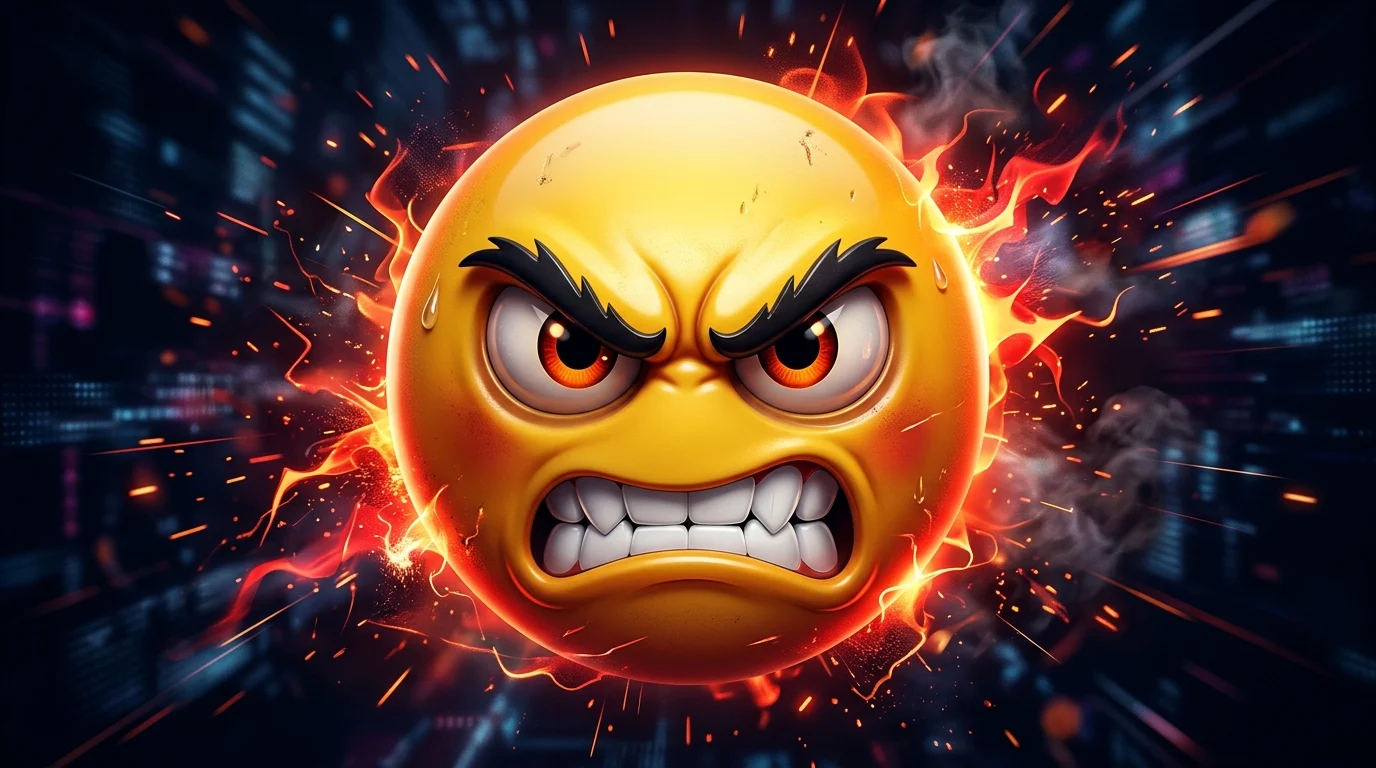
The angry emoji face 😠 is commonly used to show anger, irritation, annoyance, frustration, or displeasure. Its facial expression usually includes a frowning mouth and lowered eyebrows, making the emotion clear even without words. People use it in text messages, social media posts, comments, and online conversations when they want to express that something has upset them.
However, the exact meaning of 😠 can change depending on the conversation. It may communicate serious anger, mild annoyance, disappointment, or playful frustration. For example, “You forgot again 😠” could show genuine irritation, while “You ate the last cookie 😠” might be a humorous complaint. Understanding the context is therefore important when interpreting this emoji.
Quick Answer
The angry emoji face 😠 means anger, irritation, annoyance, or frustration. It is useful when words alone do not fully express your emotional reaction. Depending on context, 😠 can communicate anything from mild displeasure to stronger anger, although other emojis such as 😡 may suggest more intense rage.
Why Do People Confuse the Angry Emoji Face?
People sometimes confuse 😠 with other negative or angry-looking emojis because several facial expressions communicate similar emotions.
For example:
- 😠 usually suggests anger, irritation, or displeasure.
- 😡 generally expresses stronger anger or rage.
- 😤 often shows frustration, annoyance, or determination.
- 🙄 commonly expresses annoyance, disbelief, or eye-rolling.
- ☹️ usually communicates sadness or disappointment rather than anger.
The differences are not absolute. Emoji meanings can vary between people, cultures, platforms, and conversations.
First Word: “Angry”
Angry is an adjective that describes a feeling of strong displeasure or irritation.
Examples:
- I am angry with him.
- She looks angry.
- He was angry about the mistake.
- Why are you so angry?
When you use the word “angry,” you describe the emotion directly. The emoji 😠 can communicate a similar feeling visually.
Second Word: “Emoji”
An emoji is a small digital symbol or picture used to communicate an emotion, idea, object, activity, or reaction.
The word “emoji” is often used broadly for symbols such as:
- 😠 Angry face
- 😂 Face with tears of joy
- ❤️ Red heart
- 😢 Crying face
- 👍 Thumbs up
- 🎉 Party popper
Therefore, angry emoji face refers to a facial emoji that visually represents anger or irritation.
Angry Emoji Face 😠 vs Similar Emojis
| Emoji | Common meaning | Typical intensity | Example |
| 😠 | Anger, irritation, displeasure | Moderate | “I told you not to do that 😠” |
| 😡 | Strong anger, rage | High | “I am extremely angry 😡” |
| 😤 | Frustration, annoyance, determination | Moderate | “This is taking forever 😤” |
| 🙄 | Annoyance, disbelief, sarcasm | Mild–moderate | “Seriously? Again? 🙄” |
| 😒 | Displeasure, dissatisfaction | Mild–moderate | “I don’t really like this 😒” |
| ☹️ | Sadness, disappointment | Mild | “I was hoping you would come ☹️” |
These interpretations are common rather than strict rules. The surrounding message always helps determine the intended meaning.
When Should You Use the Angry Emoji Face 😠?
Use 😠 when you want to show that something has made you angry, irritated, frustrated, or displeased.
It can work well in informal conversations with friends, family, classmates, or people who understand your usual texting style.
Use 😠 for mild anger
“You didn’t tell me you were leaving 😠”
Use 😠 for irritation
“My internet stopped working again 😠”
Use 😠 for a playful complaint
“You ate my fries 😠😂”
Use 😠 after a frustrating situation
“I waited for an hour 😠”
Use 😠 to emphasize a warning
“Don’t do that again 😠”
In professional or formal communication, it is usually better to explain your concern with words rather than relying on an angry emoji.
10+ Examples of the Angry Emoji Face
Here are natural examples showing how 😠 can be used in different situations:
- “Why did you do that? 😠”
Shows direct anger or irritation. - “You forgot my birthday 😠”
Shows disappointment mixed with annoyance. - “This computer is so slow 😠”
Shows frustration. - “Stop teasing me 😠”
Shows irritation. - “I told you to wait for me 😠”
Shows displeasure. - “You took my seat 😠”
Shows annoyance. - “My phone died at the worst time 😠”
Shows frustration with a situation. - “Don’t touch my food 😠”
Shows a firm or playful warning. - “You promised you wouldn’t do that 😠”
Shows disappointment and anger. - “The bus left just as I arrived 😠”
Shows frustration. - “You really scared me 😠”
Can show anger after being frightened. - “Give me my chocolate back 😠😂”
Can express playful anger.
Common Mistakes When Using 😠
1. Assuming it always means serious anger
😠 does not necessarily mean that someone is furious. It can represent anything from mild irritation to genuine anger.
2. Using it in formal situations
An angry emoji may sound too casual or emotionally strong in a business email, school assignment, or formal complaint.
3. Ignoring the surrounding words
The same emoji can have different meanings depending on the message.
For example:
“You ate my cake 😠😂”
The laughing emoji suggests the anger may be playful.
4. Confusing 😠 with 😡
Both can communicate anger, but 😡 often appears stronger and more intense.
5. Using too many angry emojis
A message such as:
“I can’t believe you 😠😠😠😠😠😠”
may make the sender appear much more emotionally intense than intended.
Memory Trick
A simple way to remember 😠 is:
😠 = “I am not happy about this.”
Think of 😠 as a face showing displeasure. If something bothers you and you want to communicate that feeling quickly, 😠 can often fit.
For stronger anger, you may see 😡 instead.
American vs British English
The meaning of the angry emoji face 😠 is generally the same in American and British English.
However, the surrounding vocabulary can differ.
American English
- “I’m mad.”
- “I’m angry.”
- “That really annoyed me.”
British English
- “I’m angry.”
- “I’m annoyed.”
- “That really bothered me.”
In American English, mad can commonly mean angry. In British English, mad can have different meanings depending on context, so “angry” is often clearer for international learners.
Similar Words
Several English words can describe feelings associated with 😠:
Angry
Feeling strong displeasure.
“She was angry about the decision.”
Annoyed
Slightly angry because something is irritating.
“I’m annoyed by the noise.”
Irritated
Bothered or mildly angry.
“He was irritated by the constant interruptions.”
Frustrated
Upset because something is difficult or not working as expected.
“I’m frustrated because the website keeps crashing.”
Furious
Extremely angry.
“He was furious about what happened.”
Upset
Emotionally disturbed, disappointed, or unhappy.
“She was upset after hearing the news.”
Final Verdict
The angry emoji face 😠 is a flexible way to communicate anger, irritation, frustration, or displeasure in informal digital communication. Its exact strength depends on the situation and the words around it.
If you want to express ordinary anger or irritation, 😠 is often appropriate. If you want to communicate stronger anger, 😡 may appear more intense, while 😤 can be useful for frustration or exasperation.
FAQs:
What does the 😠 angry emoji mean?
The 😠 emoji commonly means anger, irritation, annoyance, frustration, or displeasure. Its exact meaning depends on the context and the accompanying message.
Is 😠 a bad emoji?
No. 😠 is not inherently bad. It simply communicates a negative emotion such as anger or irritation.
What is the difference between 😠 and 😡?
Both emojis communicate anger. 😠 commonly represents anger or irritation, while 😡 is often interpreted as stronger or more intense anger.
What does 😠 mean from a friend?
It usually means your friend is annoyed, angry, frustrated, or playfully complaining. The meaning depends on what they said before or after the emoji.
Can 😠 be used jokingly?
Yes. People sometimes use 😠 to create playful or exaggerated anger, especially when combined with laughing emojis such as 😂.
What emoji means “I’m annoyed”?
Several emojis can communicate annoyance, including 😠, 😤, 😒, and 🙄. The best choice depends on whether the feeling is anger, frustration, dissatisfaction, or disbelief.
Is 😠 stronger than 😤?
Not necessarily. 😠 more directly communicates anger, while 😤 often communicates frustration, annoyance, exasperation, or determination. Context determines the exact strength.
Can I use 😠 in a professional message?
You can, but it is usually safer to explain your concern clearly in professional communication. An angry emoji can sometimes make a message sound more emotional than intended.
Conclusion:
The angry emoji face 😠 is a common digital expression for anger, irritation, annoyance, frustration, and displeasure. It is especially useful in informal messages where a quick visual reaction can communicate an emotion more clearly than words alone. However, it does not always indicate serious anger; people may also use it jokingly or playfully.
Learn what the angry emoji face 😠 means, when to use it, how it differs from 😡 and 😤, plus examples, similar words, and FAQs.
Understanding the difference between 😠 and similar emojis such as 😡, 😤, 😒, and 🙄 can make online communication easier. When interpreting an emoji, consider both its facial expression and the surrounding conversation. That context usually provides the clearest indication of what the sender intended.

I am Emma Rose, an animal enthusiast and writer passionate about exploring animals, their unique traits, behaviors, and creative nicknames while sharing simple, engaging, and informative content with readers.